Showing posts with label Islamic Art. Show all posts

Sunday, February 14, 2016

Hürrem: the Woman who Stole the Heart of Süleyman the Magnificent

Rosa, Consort of Suleiman, Emperor of the Turks, ca. 1600-70, French School
(The Royal Collection
Today is Valentines Day, a day we tend to associate with love and lovers. From Marc Antony and Cleopatra to Romeo and Juliet, to Wallis Simpson and the Prince of Wales, there have been some great couples throughout history with stories that are the very definition of romance. There is another great love story about a great romance that took place in 16th century Istanbul that is not so well known in mainstream Western society - that of the Ottoman Sultan, Suleyman the Magnificent, and his favorite concubine, Roxelana. Their story is striking not only for the unprecedented context but also for its extraordinary contribution to Ottoman arts. Named Hürrem (meaning cheerful, smiling, blooming) upon her arrival in the Sultan's palace, Roxelana, the daughter of a Ruthenian Catholic priest, is thought to have been enslaved during a Tatar raid in western Ukraine.

 Portrait of Hurrem Sultan titled Rossa Solymanni Vxor, c. 18th century
(Topkapi Palace Museum) 
The harem of the Ottoman Sultan, filled with the most beautiful women across the land, has always been a source of exotic fantasies. Although it did house the women the Sultan took as concubines, the harem was much more than just a house for hundreds of beautiful women, trained and groomed to perfection, lounging about in hammams and on Turkish carpets awaiting for their turn to assure one man's pleasure. The harem was the Sultan's household, which also encompased the households of his mother, his favorites and concubines. The girls that came to the palace were bought at slave markets, given to the Sultan as gifts by high ranking officials or sold by their own families. Although these practices seem barbaric and impossible to understand for us, the Sultan's harem was a place for a young girl to receive a thorough education in housekeeping, gardening and languages and live in comfort and luxury. Some of the odalisques were even married off to Sultan's favorites or high ranking government officials, whereby she would be the head of her own household. There was a very strict hierarchy that everyone in the harem adhered to. Except for very rare cases, the girls deemed beautiful and/or smart enough by the Valide Sultan (the queen mother) would get further training in the arts, literature, music, dancing and of course the erotic arts.  Contrary to the Western tradition of forming alliances thorough marriage, the Ottoman Sultans made sure to use slaves for sexual reproduction assuring there would not be any other family to gain prominence or aspire for power in the empire. The Ottoman empire was a true meritocracy from the harem to its governing body. What was extraordinary about Hurrem's relationship with Suleyman was that he married her... against a 200 year tradition that inhibited Ottoman Sultans from offically marrying their concubines, even if they had borne a male heir.


Titian, La Sultana Rossa, c. 1550
The existing portraits of Hürrem, are mostly figments of the artists'  imagination since no one other than the Sultan and the eunuchs were allowed to see harem women. However she was noted for not being especially pretty. The 16th century accounts of Hürrem all attest to her intelligence and talent for strategizing. The old palace where Hürrem first resided in was in Beyazit, 2 kilometers away from Topkapi. After becoming a favorite, she managed to move into the Topkapi palace, gaining easier access to Suleyman and stay with him to the end of her life instead of moving out to the city her son would be sent, to acquire experience and rule till his father's demise. She used her influence to send off the heir apparent, Mustafa with his mother, Mahidevran, to Manisa in 1533. The first favorite who bore the Sultan a son would be the second most powerful woman in the harem, after the Valide Sultan. With Mustafa and Mahidevran out of the way, Hürrem began to rule the Harem in 1534 after her mother-in-law passed away.

Haseki Hurrem Sultan (La Rossa), c. 1540-1550
Woodcut published by Matteo Pagani
(©Trustees of the British Museum
Suleyman the Magnificent, c. 1540-50
Woodcut published by Matteo Pagani
©Trustees of the British Museum


I had written in a previous post about a series of Ottoman Sultans portraits, based on a series made by Nakkas Nigari, that existed in a Venetian collection in the 16th century. These woodcuts published by Matteo Pagani may have similar origins but their influence in later representation of the Sultan and the Sultana can be seen from the 18th century Portrait of Hurrem Sultan in the Topkapi Palace collection.  

Suleyman is noted as a 'creative conquerer' who could wield a pen as well as a sword.1 The age of Süleyman which lasted for 46 years from 1520 - 1566 is known as the Ottoman Golden Age where the arts flourished under his patronage and some of the greatest Ottoman artists lived. The great architect Sinan, the poet, thinker and writer, Fuzuli, the polymath artist, mathematician, painter and cartographer, Matrakci Nasuh, and the innovative illuminator Karamemi all lived and worked for the Ottoman Sultan at this time. The Sultan who is referred to as Suleyman the Lawgiver due to having reorganized all the archaic laws of the empire, was also a poet who wrote under the pseudonym of Muhibbi.

Illuminated pages from the Muhibbi Divani, illuminated by Karamemi  (Istanbul University Central Library, Rare Manuscripts Department)


Süleyman spent almost a third of this 46 year rule away on campaign. His ardor for Hürrem seems to have been constant which is proven by the love poems he sent to her when he was away. Muhibbi Divani was a book of Suleyman's poems which were written in Talik inscription by the calligrapher Mehmed el-Serif and illuminated with a different design on each page by Karamemi. The entire book is available digitally online to page through on a Istanbul University webpage (link). One of the poems that he wrote to his sweetheart, Hürrem is as follows:
Thorne of my lovely niche, my wealth, my love, my moonlight
My most sincere friend, my confidant, my very existence, my Sultan
The most beautiful among the beautiful...
My springtime, my merry faced love, my daytime, my sweetheart, laughing leaf...
My plants, my sweet, my rose, the one only who does not distress me in this world...
My Istanbul, my Caraman, the earth of my Anatolia
My Badakhshanmy Baghdad, my Khorasan
My woman of the beautiful hair, my love of the slanted brow, my love of eyes full of mischief...
I'll sing your praises always
I, lover of the tormented heart, Muhibbi of the eyes full of tears, I am happy. 
 Despite being the beloved and dear wife of one of the most successful Sultans of the Ottoman Empire, Hürrem has always been remembered as the scheming, evil female who turned the tide of history by instigating the execution of Suleyman's first-born Mustafa, his closest aid and grand vizier Pargali Ibrahim Pasha and placing her son-in-law Rustem Pasha and her other supporters in high places within the government. It is a well-known fact that she had great influence and advised Suleyman in matters of the state. Although she was not revered as she should be, she was the inspiration for many European artists including Haydn who titled the second movement in his Symphony no. 63 Roxelane. Being an intelligent, powerful woman, Hürrem also knew the power of royal patronage in promoting a positive public image, which is why she commissioned from the architect Sinan religious complexes, waterways, hamams and soup kitchens throughout the empire including Istanbul and Jerusalem.  Unfortunately, none of her good works were enough to cleanse Hürrem's reputation who is to this day still remembered as a nefarious temptress, but Süleyman's poems reveal how special she was to one of the most powerful emperors in history.


1 Halman, Talat Sait. Süleyman the Magnificent Poet: The Sultan's Selected Poems, Beyoglu, Istanbul, Türkiye: Dost, 1987

Thursday, April 3, 2014

Image of the "El Turco" in Quattrocento Italy


Pinturicchio, St Catherine's Disputation, 1492-94
(Sala dei Santi of the Borgia Apartments, Vatican)
"I am not Italian, I am not an art historian, a student or even an academic and I am not even Christian! How many Turks do you see running around Italy, blogging about galleries and churches full of Madonnas and Saints... none! For years something in me searched for a way to connect with others. I found it in art and particularly in the faces and graceful poses of one particular artist whose works seemed to call me to action." 
                                                                                               -  Hasan Niyazi 
That artist was of course, Raphael, which is why we are honoring Hasan's memory and the light he brought to our lives on Raphael's birthday, April 6, 2014. Hasan connected, inspired, impelled so many of us to stretch the boundaries of our potential, vision and purpose, making us see what was right in front of us in a whole new way... today we are doing our best to continue the conversation that was so abruptly interrupted on October 28, 2013. This post will be part of a virtual collaboration, #raphaelhasan, celebrating the life of Hasan Niyazi.

Here are a few images of "El Turco" standing around in Italy.

Standing Man,  Workshop of Gentile Bellini,
(late fifteenth century)
(Stadelsches Kunstinstitut, Frankfurt)
After his famous expedition to Istanbul which resulted in the most widely recognized likeness of an Ottoman Sultan, Gentile Bellini is cited as being one of the most credible sources for the Oriental mode in Venetian painting. The conquest of Constantinople by Sultan Mehmet II in 1453 brought Europe in direct contact with the Ottoman Turks arousing great interest in the customs and manner of dress of these "Orientals." Bellini was not the only source of information however, visiting merchants and the ambassadors also provided the Venetians with eyewitness accounts. Generally accepted as the work of Gentile Bellini, the several drawings of Turks which have been attributed to Costanza Ferrara by Julian Raby, do seem to be quite authentic in their costumes and visage.[1]

Procession in the Piazza San Marco, Gentile Bellini, 1496
(Galleria dell'academia, Venice) 
There are many legends regarding Sultan Mehmet II's library and collections with its priceless Bibles, Torahs along with precious Qurans, antique and Persian manuscripts. Philippe de Montebello has even claimed Mehmed II's collection as the first Universal Museum.[2]  One of the most intriguing items allegedly displayed there was a Madonna and Child in front of which Mehmet kept candles burning. Bellini was commissioned to paint a manuscript illumination of the Madonna and Child as well as frescoes for one of the four pavilions Mehmet II was building inside his new palace compound. Unfortunately, only the Persian Pavilion survives to our present day as the Tiled Kiosk on the grounds of the Archaeological Museum. 

Pinturicchio, The Martyrdom of Saint Sebastian, 1492-94
(Sala dei Santi of the Borgia Apartments, Vatican)
Seated Janissary, Gentile Bellini 1479-81
(British Museum)
Styling himself as the new Alexander the Great, it has been suggested that Mehmet II invited Bellini into his household and intimate circle, emulating Alexander's relationship with his favorite artist, Apelles. After spending a year in the Sultan's household, Gentile Bellini returned to Venice bearing gifts: the most precious of these were a gold medallion and chain, a letter bearing the Sultan's Tugra, commending Bellini, and a Knighthood of the Golden Spur. Bellini's impressions from his trip to exotic Istanbul has been noted in two of his paintings, in some minor architectural details of Saint Mark Preaching in Alexandria and three turbaned figures in the background of the Procession in the Piazza San Marco which are thought to be the inspiration for Durer's drawing Three Standing Orientals.

Pope Pius II in the Port of Ancona, Pinturicchio, 1505-07
(Piccolomini Library, Siena)
By the sixteenth-century the Turk had become a familiar and accurately depicted figure in Italian art. Some of the best examples of this trend can be found in the frescoes Pinturicchio painted for Sala dei Santi in the Borgia Apartments in the Vatican Palace where he used Bellini's Standing Man and Standing Turk exactly as they appear in his drawings; meanwhile The Seated Janissary can be seen in his Martyrdom of Saint Sebastian.  Finally, in Pinturicchio's fresco of Pope Pius II in the Port of Ancona (while embarking on a Crusade), the figure of the standing Turk (at the far right) has been identified as Cem Sultan, Mehmed II's younger son who was a hostage and eventually died at the papal court.

The Seated Scribe, Gentile Bellini, 1479-80
(Isabella Stewart Gardner Museum, Boston)

The Seated Scribe representing an imperial page, probably like the ones Bellini encountered daily in the palace, after some debate has been attributed to Gentile Bellini. It is a pen in brown ink drawing which has been painted using water color and gold on paper. The method of production as well as the coloring has been noted as responding to the Islamic influence the artist had been exposed to in Mehmet's court.  I like to think of this particular drawing as the visual manifestation of the confluence of ideas and traditions between east and west for a brief moment in time.

Europe and the Ottoman Turks lived together as neighbors, rivals and trading partners for four more centuries, the changing political conditions dictating how each saw and represented the other. According to Giovanni-Maria Angiolello, after Mehmet's death, his son and successor, Beyazit II had his father's portrait along with other Western paintings sold in the Bazaar where they were acquired by Venetian merchants. The works Gentile Bellini produced in Istanbul, disposed of in such a hasty fashion went on to become sources of inspiration for European artists for many centuries to come.

[1] Julian Raby, Venice, Durer and the Oriental Mode, Islamic Art Publications, 1982
[2] Philippe de Montebello, Whose Culture? The Promise of Museums and the Debate over Antiquities, "And What Do You Propose Should be Done with Those Objects?"Princeton UP, Princeton, 2009

Sources

Caroline Campbell, Alan Chong, Deborah Howar, J. M rogers, and Sylvia Auld, Bellini and the East, London: National Gallery, 2006

Stefano Carboni, Venice and the Islamic World, 828-1797, New Haven, CT: Yale UP, 2007

Julian Raby, Venice, Durer and the Oriental Mode, Islamic Art Publications, 1982

James B. Cuno, Whose Culture? The Promise of Museums and the Debate over Antiquities, Princeton UP, Princeton, 2009

Saturday, January 25, 2014

Ottoman Princess Mihrimah Sultan

Cameria, Daughter of the Emperor Soliman,
After Cristofano dell' Altissimo, 16th century(?)
(Pera Museum)
The Ottomans have always been a source of fascination, even for citizens of the Turkish Republic, whose knowledge of its more than 600 years of history is still a work in progress. While everyone who has attended school in Turkey would have a rudimentary knowledge of the names and some standard accomplishments of the Ottoman Sultans, the imperial women and their accomplishments are either ignored or mentioned within a negative context. A whole nation, for generations, still does not seem to have been able to get over the fact that Suleyman the Magnificent, legally married Hurrem, forsaking all others, when he was the most powerful man on earth (God's shadow on earth) The concubines in the Harem would rise up to become Haseki Sultan's when they bore a son but were never granted the privilege of becoming the Sultan's wife. While the daughters of the Sultans had a special place within the palace hierarchy and extreme power over their husbands, they are still remembered only in relation to their fathers or husbands - the details of their lives all too often escaping our notice completely. There were few exceptions, one in particular I just had to mention here today...

Mihrimah Sultan, the only daughter of Suleyman the Magnificent and his beloved wife, Hurrem Sultan, was one of the most influential and powerful women in 16th century Ottoman Empire. Almost a contemporary of Queen Elizabeth the Ist of England, born in 1522, Mihrimah died on January 25, 1578, leaving behind a substantial legacy of pious foundations and architectural commissions. She is best known for her two mosque complexes in Uskudar and Edirnekapi districts of Istanbul, both the work of the great architect Sinan. Her letters to her father as well as the one she wrote to King Sigismund II of Poland upon his accession to the throne congratulating him is thought to attest to her superior education and involvement in diplomacy. [1]

Saturday, March 2, 2013

Historians of Islamic Art Association at #CAA 2013

Post made possible thanks to the support of  3pipe.net 

Leighton House, Arab Hall, London

As art historians and lovers of art, our primary objective is looking, and deciphering the significance of the artifacts before us. We try to assign meanings to our observations in accordance with our own knowledge and experiences. But when it comes to the art and culture of the Near East, the complexity of collecting, displaying as well as assisting the general public in cultivating a greater understanding of these objects that have been taken out of their original context and transported to another realm is an omnipresent one. At the College Art Association's 101's annual conference in New York two weeks ago, in the panel organized by the Historians of Islamic Art Association, these issues were exposed and discussed in all their vividness.

From personal ancestry to experience, there are many factors contributing to my particular area of interests in the history of art. Having lived in Istanbul, historically one of the richest and most diverse cities in all of Europe and the world, have left me with a curiosity towards all the civilizations that have permeated the landscape and culture of my beautiful hometown. Which is why of all the intriguing topics discussed, I was particularly drawn to the panel "Between Maker, Agent, Collector, Curator, and Conservator:  Interdisciplinary Approaches to the Study of Islamic Tilework."

Saturday, December 22, 2012

Reading History Through Jewellery

Square emerald aigrette, TSM 2/313, 18th century
(Topkapi Palace Musem)
"Made up of the glories of the most precious gems, to describe them is a matter of inexpressible difficulty. For there is amongst them the gentler fire of the ruby, there is the rich purple of the amethyst, there is the sea-green of the emerald, and all shining together in an indescribable union. Others, by an excessive heightening of their hues equal all the colours of the painter, others the flame of burning brimstone, or of a fire quickened by oil." 
                                                    ~ Pliny the Elder (describing opals)
From philosopher to the ordinary woman/man for centuries jewels have been a source of fascination; their natural brilliance, vibrant colors and expressiveness have been compared to all the wonders of the universe.  But jewelry, as part of the persona of a sovereign has greater connotations than mere beauty or worth - it becomes a symbol of imperial magnificence portraying their might and refinement concurrently. When the sovereign in question is the Ottoman Sultan these symbols take on a more exotic, intriguing configuration that may need further elucidation.  During a talk about her latest book, Imperial Ottoman Jewellery: Reading History Through Jewellery, Prof. Dr. Gul Irepoglu provided some enlightening facts as well as stunning visuals of the jewelry of the Ottoman Sultans. One of the most interesting parts of her talk was the inclusion of miniatures, which are considered to be historical documents, to highlight where and how these jewels were utilized.

Sunday, November 25, 2012

Queen Elizabeth I to Sultan Murad III - Imperial Imagery


att. George Gower, Queen Elizabeth I, 1588
(National Portrait Gallery, London) 
This portrait of Queen Elizabeth I painted in honor of the biggest victory of her reign over the Spanish Armada of 1588 brings back a distant memory of standing in the middle of the National Portrait Gallery, listening to my niece relaying the story of having to count the pearls on the queen's dress for a school assignment. While we stood before the life-size portrait of 'Bess', admiring the elaborate treatment of the surfaces and observing her intrinsic features, I realized we did not have any equivalent to this, from our own history except for the one portrait, The Sultan Mehmed II, by Gentile Bellini.  In an earlier post, I had discussed the mobility of artists, influences and ideas as well as works of art in the fifteenth-century in regards to Mehmed II.  However, after Mehmed's death, commissions for portraiture in the Italian Quattrocento tradition seems to completely disappear from the Ottoman court.  The common belief that this was due to the religious inclinations of Bayezid II seems to be unanimous.  As a consequence of this, instead of portrait galleries full of life-size, oil on canvas likenesses of the Ottoman Sultans, Topkapi Palace museum contains folios full of manuscript illuminations with depictions in the Ottoman tradition.  What I want to discuss here is where the images for the Sultan portraits in these manuscripts came from if no known likenesses existed?

Friday, October 5, 2012

The Renaissance Portraits from the Courts of Italy to the Ottoman Empire

Gentile Bellini, The Sultan Mehmet II, 1480
(National Gallery, London)

"Bellini portrayed Sultan Mehmed from life so well, that it was considered a miracle."
                                                                                                      - Giorgio Vasari

Of all the genres in the history of art, portraiture has a very special place due to its intimate nature of enabling vis-a-vis encounters with illustrious figures from the past.  The Renaissance Portrait from Donatello to Bellini exhibit at the Metropolitan Museum of Art earlier this year was a great example of the art of depicting likenesses transcending centuries and making the absent present more than five hundred years after the portraits had been made. One of the highlights of the exhibit was the gallery devoted to portrait medals featuring primarily the works by Antonio Pisanello who is ascribed as the inventor of the portrait medal in Quattrocento. The portrait medal that was utilized by rulers of the Italian Renaissance to cultivate their image pertaining to their right to rule, lineage and intellectual capacity is a fascinating symbol of the philosophy of the the time.  It also is a great testament to the mobility of artists, ideas and influences as well as works of art - all of which can be garnered from examining Pisanello's body of work and it's effects as it pertains to the portrait medal. This mobility and influence seems to have extended out to the most eastern reaches of Europe, to a land that was ruled by Turks, the Ottoman Empire.

Antonio Pisanello,
Studies of Emperor John VIII Palaeologus and Members of the Greek Delegation to the Council of Ferrara and Florence, 1438-39
(Musee du Louvre, Paris)

In the absence of sources as to the artist or real intent of a work of art, most of the conclusions made have to be based on conjecture but following the visual clues that have survived enables even a novice a fascinating view into an enchanting period in history. I assume the best way to embark upon such a journey should be chronologically.  The medallion, John VIII Palaeologus by Pisanello is accepted as the first Renaissance portrait medal which was supposed to have been cast on the occasion of the Byzantine emperor's visit to Ferrara for the council to reunite the Eastern and Western Churches. The Eastern delegation is said to have really fascinated the Italians with their colorful costumes and interesting ways (the Emperor was out hunting instead of sitting in on the meetings) inspiring Pisanello to make the detailed drawings seen above.

Monday, July 16, 2012

Cross-Cultural Comparisons Between Colonial Latin America and the Islamic World

"Threads of Every Color" 
by Michael Schreffler 

Ceiling,  16th century, Spain
(Metropolitan Museum of Art)

The exchange of ideas, the fusion of diverse cultures and the expressions that emanate from the extension of these influences are some of the most fascinating aspects of art history.  One excellent example of this exchange is the wooden sixteenth century Spanish church ceiling in the Koc Family Galleries (Gallery 459) at the Metropolitan Museum of Art's newly renovated galleries for Islamic art.  The Met gallery label states "The ceiling covering this gallery is a testament to the resilience and persistence of traditional Islamic design in Andalusia after the Christian Reconquista."  This exquisite ceiling, a representative of the influence of Islamic design in art and architecture on non-Muslim societies, however, is not the first of its kind that has made its way across the Atlantic between Spain and the Americas.  Actually the mudejar style, was transported to the "New World" at the end of the sixteenth century with the arrival of the Spanish conquerors. This in itself might not be a surprising revelation, but I found the discourse on the transference of the concept of "the Other" by the colonialists onto the people and the culture of Latin America outlined with fascinating examples in a research paper by Dr. Michael Schreffler quite revelatory.

Sunday, July 1, 2012

Byzantium and Islam : Age of Transition


Although my ancestors are from Asia Minor, the geography that has been identified as the Heartland of Byzantium, and I spent most of my life in its capital city, Istanbul (Constantinople) where the biggest monument to this once great empire, the Hagia Sophia, is part of the backdrop of everyday life, there was something I always found a little elusive in deciphering the Byzantine civilization and culture.  Considering Byzantium was actually an extension of the Greco-Roman culture which happens to form the foundations of the predominant culture in the West today, it is actually quite surprising how little is clearly known of this once central power of late antiquity and early middle ages, especially in contrast to the obsession we seem to possess for the culture of ancient Greece and Rome.  Thanks to the enlightening exhibition going on at the Metropolitan Museum of Art that is due to close on July 8th, I feel I have finally found some of the clues to these curious concepts.

Saturday, February 18, 2012

A Transcendent Experience - Philipp Otto Runge's Morning

Philipp Otto Runge, Morning, 1808
(Hamburger Kunsthalle)

"A man should hear a little music, read a little poetry, and see a fine picture everyday of his life, in order that worldly cares may not obliterate the sense of the beautiful which God has implanted in the human soul."
- Johann Wolfgang Goethe


I have been obsessed with Philipp Otto Runge's Morning, ever since I first heard of it in a German Romanticism class.  I think there was something about it that resonated with what I was familiar with in Islamic manuscript painting.  The style and symmetry of Runge's composition, the expressive use of  color and elements from nature, and especially the frame, all added to the similarities  between the two traditions in my personal opinion.  I should probably admit that most of these observations may be a bit cursory and although the painted frame reminiscent of Islamic illuminations is an integral part of the painting in Morning, it is interpreted in the Renaissance tradition, as validating this as a work of art or the open window to the world outside.  

Sunday, November 13, 2011

Patronage and Secular Subject Matter in Islamic Art


Islamic Art's unique artistic language can sometimes be difficult to read in terms of western iconography due to its foundations in the Islamic way of life that is guided directly by the laws of the religion.  Rarely have I witnessed information that has made the connection between Western and Islamic patrons and the art produced for them so clear as the lecture I listened to by Jerrilyn Dodds last week. My desire to communicate all the wonderful wisdom I garnered after listening to her lecture lead me down a path that was familiar yet remote at the same time, finally culminating in the Garden of Eden that I never fail to find in art.

Jerrilynn Dodds, Dean of Sarah Lawrence College has been giving a three part lecture series, Islamic Art and Society, in conjunction with the opening of the New Galleries for the art of the Arab Lands, Turkey, Iran, Central Asia and Later South Asia at the Metropolitan Museum of Art.  I was lucky enough to attend the second in the series, Luxury Arts and the Art of the Book which focused on the secular elements used in the representation of Islamic kingship.  Dodds presented an interesting perspective on the patrons and the content of these works of art.


The 10th century plate with Arabic Inscription  from Iran, that greets you as soon as you enter the New Galleries was the object Dodds started her discussion with. The prosaic inscription "Planning before work protects you from regret; prosperity and peace" she mused has a Hallmark-like quality.  Dodds' interpretation of the abstract design as the desire of people wanting to be engaged intellectually was and idea that held great appeal.


The second object Dodds talked about was a oliphant Hunting Horn similar to the one on the left.  The value of the material attesting to the magnitude of the ruler and images of animate beings to his liberal understanding of Islam.  The hunting horn was decorated with hunting animals and the mythological figure, Harpy.  Dodds defined an Islamic ruler owning such an object as his right to own land, to hunt and as a reminder of these privileges to his people.  She also connected the images of animals to the myth of palace art and mentioned Arabian Nights written at the time of the Abbasids, as deliberating the rights of Kings.

Next, we touched upon the Golden Age of Islam (9th-12th century) a time for great intellectual and cultural creativity, when intellectuals had found and translated into Arabic the classical manuscripts from antiquity.  Dodds mentioned the great curiosity for science and philosophy at this time.  The richest city in the world, Baghdad,  founded by the Abbasids, was syncretic compounding Hellenistic, Christian, Persian, Jewish, Zoroastrian and Hindu ideas. The following manuscripts were the visual manifestations of the connection and influence of these different cultures on Islamic culture.

Arabic Translation of the
Materia Medica of Dioscorides, 1229
Topkapi Palace, istanbul
Page from Dispersed Manuscript of an Arabic Translation
of the Materia Medica of Dioscorides,
Abdallah ibn al-Fadl, 1224, Iraq
Gallery 454


Byzantine miniature of Saint Mark,
mid to late 12th century
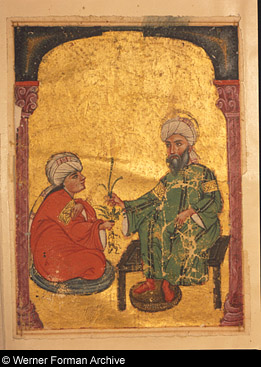
In conjunction with the Golden Age of Islam, there came another part of Islamic Kingship, learnedness. They learned about science and medicine from the classical manuscripts. The Manuscript of Materia Medica of Dioscorides, translated into Arabic give us a visual understanding of the level of influence all the different cultures had on the Islamic rulers.  Professor Dodds compared the gold background and the chiaroscuro seen in the manuscript that is in the Topkapi Palace collection with Byzantine miniatures. She pointed out the figures represented dressed as Arabs while the figures in the Metropolitan's manuscript having halos over their heads.

Astrolabe of 'Umar ibn Yusuf '
1291, Yemen
Gallery 454
The wisdom and innovations of the scholars extended to the development of scientific instruments as well. The Astrolabe of 'Umar ibn Yusuf ibn 'Umar ibn 'Ali ibn Rasul al-Muzaffari, made and signed by the Rasulid prince al-Ashraf, later Sultan of Yemen, is an instrument that showed the Quibla, so they could pray facing Mecca five times a day.  It was mentioned that since they were mostly a nomadic people, this was a crucially important instrument to own for Muslims.  Dodds added that all these innovations, "they gave back to the West when the West was ready to receive them."

From the Book of Knowledge of Ingenious
Mechanical Devices by al-Jazari
1315, Syria
Gallery 454
The interest in engineering prompted what Professor Dodds referred to as the Sultan's magical toys.  Al-Jazari, who we might refer to as a mechanical engineer today, built this elaborate Elephant Clock in order to celebrate the diversity of mankind. Al- Jazari used Greek (Archimedes) water principles combined with an Indian water timing device (ghati), an Indian elephant, an Egyptian phoenix, Arabian figures, a Persian carpet and Chinese dragons.  The features also symbolized countries and trade, and each animal had a myth associated with it: the elephant was a symbol of royalty, the phoenix of rebirth and life, the dragon of power and impregnability.1  The King of Diyabakir, Nasir al-Din, the Artuquid asked Al-Jazari, who was in his service to document his inventions in a manual, the 'Knowledge of Ingenious Mechanical Devices' which he completed in 1206.2


al-Wasiti, Yahya ben Mahmud Al-Hariri's Maqamat
Baghdad, 1237
(Bibliotheque Nationale, Paris)
One of the greatest Arabic Illuminated manuscripts of all time, was the Maqamat Al-Hariri which was a collection of short stories by al-Hariri that were Illustrated by Yahya ibn Mahmud al-Wasiti.  The hero of the stories is a character named Abu Zayd, an itinerant rascal, who lives off the world by his wits and by his knowledge, sometimes dishonestly, but who succeeds in extricating himself from difficult situations or coercing others to assent to his needs because of his incomparable use of the Arabic language.  The great appeal of these illuminations from the time of their conception is the realism in depicting everyday life from birth to death of the urban Arab middle class  world in the 13th century.


Caravan of Pilgrims traveling to Mecca,
al-Wasiti, Yahya ben Mahmud Al-Hariri's Maqamat
Baghdad, 1237
(Bibliotheque Nationale, Paris)
      
A Literary Reunion, al-Hariri's Maqamat,
(Institute of Oriental Studies,
St. Petersburg,  Russia)


Woman with a herd of Camels,
al-Wasiti, Yahya ben Mahmud Al-Hariri's Maqamat
Baghdad, 1237
(Bibliotheque Nationale, Paris)
Everything is represented in profile but especially in the Woman with a Herd of Camels the artist took realistic features of the animals like the long neck and the prehistoric head, the open mouth and awkward legs, the pompous gait and stance and recomposed these elements in a rhythmic pattern of legs, necks, humps and heads. 3  In this genre scene, Jerrilynn Dodds stated that the pattern was set in a two dimensional space with repetition, the notion of abstract design on the surface of the painting reinforced by its representation on the side of the text.  Also due to it not being a window into reality, as in Alberti's concept of art, the manuscript is supposed to have real status as writing itself and this takes the power of the image from seducing its viewer, corresponding with Islamic philosophy.  I found the lines that were drawn through the necks of the figures in the Literary Reunion, thought provoking after Dodds mentioned it and questioned if this was a way someone had thought to kill them.

Rashid al-Din Fazl-Allah, Jami al-Tavarikh
Iran, 1400
(Metropolitan Museum of Art)
After the Maqamat, Dodds moved onto another fascinating manuscript, Rashid al-Din Fazl-Allah's Jami al-Tavarikh (Universal History).  Rashid al-Din, a Persian physician and vizier to the Mongol Emperor who converted to Islam, Ghazan Khan, was commissioned by the emperor to write the history of the Mongols and their dynasty which later expanded to include history of the world from Adam to their contemporary time.  This manuscript is made up of stories of contemporary life with ancient legends, myths, the story of the prophet Mohammed as well as stories of Christian and ancient history woven into the late Mongol era, as their own history.  With this ambitious project they ensured the belief in their people of the Mongols being the continuation of all the other great civilizations.  The illumination on the left is about the story of Jonah and the Whale from the bible.

Eskandar (Alexander the Great) enters the Land of Darkness,
Rashid al-Din Fazl-Allah, Jami al-Tavarikh,
Iran, 1314
(Edinburgh University Library)

In the illumination on the right, a very Mongol looking Eskandar, Alexander the Great, sends his horse forward into the swirling darkness.  Uncertainty is in the air as his followers look anxious and even two of the horses stare at each other. The flame-like protuberances on his helmet probably allude to his identification with the qur'anic figure Dhu'l-Qarnayn ('Lord, or Possessor, of Two Horns').The Chinese influence brought by the Mongols can very easily be detected in the cloud formations.


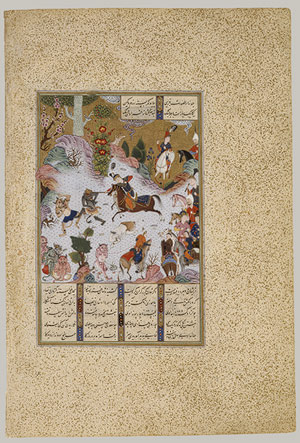
If Rashid al-Din's Jami as-Tawarikh was the history of the Mongols, the Shahnameh or the 'Book of Kings', the most important creation of New Persian Literature, was the national epic of the Iranian people.  Written by Ferdowsi, twice as long as Homer's Iliad and Odysseus taken together, it blended Iran's ancient myths and legends with accounts of major events in its past, celebrating the survival of a civilization that went back 7000 years.5  The first known illustrated copies of the Shahnameh date from the time shortly after the Mongols conversion to Islam under Ghazan Khan (1295 -1304). Ghazan and the succeeding Islamic emperors considered art patronage as a reflection of the majesty of their kingship. The emergence of Persian manuscript painting which was also the regeneration of Iran's political power under the Mongols coincides with this era.  The Shahname was a source of  pride for Iran who was recovering its territorial, political and cultural history.6   There are many copies present because commissioning opulent copies of the Shahname became almost a  royal duty.  The stories lent themselves to heroic actions, dramatic deeds and divine glory.


Iskandar (Alexander the Great) at the talking tree.
Shahnameh, Il-Khanid period, 1330- 1336
Iran, Tabriz
(Freer Gallery of Art)
Zal is sighted by a caravan
Shahnameh, Attributed to Abdul Aziz
Iran, Tabriz, Safavid Period, 1525
(Art and History Collection LTS)
Isfandiyar's Funeral Procession
from the Great Mongol Shahnama

Iran, Tabriz, 1330's
(Metropolitan Museum of Art)


The Feast of Sada, Shahnama of Shah Tahmasp
Attributed to Sultan Muhammad,
Iran, Tabriz 1525
(Metropolitan Museum of Art)
According to Jerrilynn Dodds these miniatures are a mirror of kingship, pointing out the qualities a king should possess, strength as well as cunning. There is also a sense of mysticism, the artists creating an alternate reality thorough art.  The naturalism of the plants almost to the point of being botanical does not seem to apply to the humans.  The profusion of colors, imaginative iconography and the strangely abstract quality of these manuscripts very easily being able to take the viewer into a beautiful fantasy world.

The Court of Gayumars,Shahnama of Shah Tahmasp
Iran, Safavid, 1522-1525
(Aga Khan Museum, Toronto, Canada)
        
Tahmuras Defeats the Divs, 
Shahnama of Shah Tahmasp
Iran, Tabriz,  1522-1524
(Metropolitan Museum of Art)
The Emperor's Carpet detail
Iran, second half 16th century
Gallery 462
Looking at the design of this carpet reveals the role of the miniaturist in the design of carpets, similar to the western artists designing cartoons for tapestries.   The main protagonists of the fantastical world represented on The Emperor's Carpet are the demonic creatures divs.  These can be seen in many of the miniatures as well, usually in the process of being killed.  According to legend, in order to have their lives spared, divs promised to teach man the precious art of writing.  This is how humankind learned various languages including Arabic, Chinese, Greek, Persian and Sogdian.Dodds classified all of these as a secular play-world culture.


The Safavid Prince Haidar Mirza's Entrance to Istanbul in 1590
from the Divan of Mahmud Abd al-Baki

Ottoman Iraq, Baghdad, 1590-95
(Metropolitan Museum of Art)
           
The Shaikh al-Islam Discoursing to an Audience
from the Divan of Mahmud Abd al-Baki

Ottoman Iraq, Baghdad, 1590-95
(Metropolitan Museum of Art)
Eventually, when we got to the Ottomans, Jerrilynn Dodds made a pronouncement that was both logical and obvious- they were very organized.  She pointed out how there was a system, an easily recognizable hierarchy between the elements, clear, rational volumes making the images readable.   The most important figures are represented as the biggest and then according to their importance the figures get smaller. This actually mirrors how Ottoman society functioned where everyone had a place and even a specific form of dress, making it very easy to identify who one was dealing with, this in turn would make the reading of representational artwork easier as well.


When viewing the above miniatures with these concepts in mind, it is amusing to see that the Shaikh al-Islam (the most senior religious official similar to an archbishop) is the most important personage in the miniature on the left since his turban is huge. The hierarchy becomes even more pronounced in a military scene with all the different ranks lined up next to one another.   There are some very intriguing details that caught my attention in the above miniatures. First was the way the artist handled the tree in the Shaikh al-Islam miniature; it starts out as almost a painting or a window on the wall behind him and then comes out of the picture plane to become a part of the border decoration forming a connection between the border and the inner picture. This is a very interesting concept since in miniature painting as in illumination there are very strict rules that dictate how a page is supposed to be set up and artists are limited from realistic representation.  I like to think that in doing so, the artist used artistic license to break thorough the limiting barriers set forth.


The back view of Prince Haidar entering the city in the miniature on the right is another that merits furter investigation.  The foreshortening, the almost natural gait of the horse are little details that seem to be little secrets hiding in open sight.


Tughra of Sultan Suleiman the Magnificient,
Ottoman Turkey, Istanbul, 1555
This magnificent work of art is the very befitting signature of the Ottoman Sultan Suleiman the Magnificent. The time of Suleiman's long reign in the 16th century is considered to be the zenith of Ottoman art.  Although the names of most illuminators or miniaturists do not survive, we have the names of some of the extraordinary talents that were working in the nakkashane (palace artists' atelier) in Topkapi Palace around this time. The naturalistic floral designs used in the decoration of the Tughra were an innovation that was introduced by Kara Memi who was the head of the nakkashane.  Each area illuminated contains different forms and styles - rumi, hatayi (floral), halic (the circular flower motif)- that artists utilized in the manuscript illuminations from this period.

It is said that   "The Qur'an was revealed in Mecca, Read in Cairo and Written in Istanbul."   - this particular quote I think, explains the prominence of Ottoman calligraphy and illumination in Islamic art.  Of course, it is impossible to ignore the influence of Tabriz since the artists from the area immigrated to Istanbul after the conquest of Selim I, of the city in 1514.  Another story from history that sheds light on the high regard with which the Ottomans held the art of the book, is that Selim I (Suleiman's father) who was known for his fierceness was said to have held his calligraphy master's ink pot while he worked.

Gentile Bellini, Portrait of Mehmed II, 1480
dated 25 November 1480
(The National Gallery, London)
Sultan Mehmet II Smelling a Rose
Ahmed Siblizade, 1480
(Topkapi Palace Museum Library, Istanbul)


Gentile Bellini painted this portrait of Sultan Mehmet II during a 'state-sponsored" visit to Istanbul.  Sultan Mehmet is portrayed  under a marble arch, a universal symbol of triumph appropriate for the Sultan who conquered Constantinople in 1453. The fictive framework within the painting, although not of any consequence for the Ottoman court artists, demonstrates Gentile's ability to creates a three dimensional space, one of the primary virtues of Italian Renaissance painting. 8 It is very interesting to compare this portraits side by side with the miniature from the same period by the Ottoman court painter Ahmed Siblizade and pick out the influences as well as the differences in their respective approaches to the same sitter.  While the Belini represents the consummate ruler with allusions to the lands he ruled in the form of the golden crowns lined up around him, the jewel encrusted cloth hanging over the parapet, and a bored expression on his face, the Ottoman miniature has the conqueror of the capital of the Byzantine empire smelling a rose.

Alexander visits the Sage Plato, from Khamsa (Qunitet) of Amir Khusrau Dihlavi,
attributed to Basawan, Pakistan, Lahore, 1597-98
(Metropolitan Museum of Art)
Next we come to India and the Islamic Mughal dynasty. The fourth book of Amir Khusrau Dihlavi's reprise of Nizami's Khamsa, is The Mirror of Alexander,which are mythic  tales from Alexander's life.  In this manuscript produced for the emperor Akbar, who is attributed as being the first great Mughal patron of the arts, Alexander takes on the visage of a Mughal emperor.  Jerrilynn Dodds pointed out during her lecture that there is a sense of space and depth in this work that is mostly lacking in Islamic miniatures as well as atmospheric perspective up in the top part of the picture.   The unique Mughal style of painting is due to Akbars founding a royal atelier from which he commissioned numerous illuminated manuscripts  baring influences of Persian, Indian and even European elements. Persian, Indian Muslim, and Hindu artists worked together to form the particular Mughal style which was further developed in the 17th century.9

Portrait of Shah Jahan on Horseback
India, 17th Century
(Metropolitan Museum of Art)
Portrait of Shah Jahan on Horseback
:Leaf from the Shah Jahan album
,
attributed to Payag, 1628
(Metropolitan Museum of Art)


The unique style of painting initiated during the reign of Akbar developed into a more naturalistic style worked out using European artistic techniques like perspective and chiaroscuro by the 17th century.   Looking at the two portraits of Shah Jahan that Jerrilynn Dodds referred to as passage portraits, it is interesting to note the horse and the flora rendered naturalistically while the surface is still left flat.  Unlike earlier Islamic miniatures which were the illustrations for an accompanying text, these studies seem to be individualized portraits. One of the most prominent feature of these portraits is the use of distinct Western iconography; I just love the halos around Shah Jahan's head and the putti that seem so familiar in such an unexpected context.

Over centuries of existing with and absorbing other cultures, Islamic patrons as well as artists seem to have found a visual vocabulary of their own that exists within the restriction placed on the representation of living beings.   The boundaries set before them seems to have set them on a path toward abstraction and an incredibly imaginative pictorial language.  Dodds has a very elegant explanation for these boundaries as the way to eviscerate being seduced by images in order to reach the divine.  Finally, Jerrilynn Dodd's closing remark is one I take to heart and feel explains not just the reasoning of abstraction in Islamic representation but also my personal philosophy -  "Most profound personal truths can be found only intellectually."


1  Al Hassani, Salim T. S., Elizabeth Woodcock, and Rabah Saoud. "The Elephant Clock." 1001 Inventions:  Muslim Heritage in Our World. 2nc ed. Manchester, Great Britain:  Foundation for Science Technology and Civilisation, 2007. 16. Print
2  Ibid., 316
3  Grabar, Oleg. Islamic Visual Culture, 1100-1800. Aldershot, England:  Ashgate/Variorum. 2006.  Print
4  "The Fitzwilliam Museum :  An Explosion of Images." The Fitzwilliam Museum : Home. Web. 11 Nov. 2011 <http://www.fitzmuseum.cam.ac.uk/gallery/shahnameh/vgallery/section2.html?p=26>
5  Ibid., <http://www.fitzmuseum.cam.ac.uk/gallery/shahnameh/index.html>
6  Ibid., <http://www.fitzmuseum.cam.ac.uk/gallery/shahnameh/patronage.html>
7  Welch, Stuart C. "78 Pictures from a World of Kings, Heroes, and Demons:  The Houghton Shah-nameh."  The Metropolitan Museum of Art Bulletin 29.8 (1971): 341-57. Print
8  Carboni, Stefano. Venice and the Islamic World:  828 - 1797 : Intitut Du Monde Arabe, Paris, Ocotober 2, 2006 - February 18, 2007: The Metropolitan Museum of Art, New York, March 27 - July 8, 2007.  New York: Metropolitan Museum of Art [u.a., 2007. 303. Print
9  Department of Islamic Art.  "The Art of the Mughals before 1600". In Heilbrunn Timeline of Art History.  New York:  The Metropolitan Museum of Art, 2000 - http://www.metmuseum.org/toah/hd/mugh/hd_mugh.htm (October 2002)

Related Posts Plugin for WordPress, Blogger...