Showing posts with label Renaissance. Show all posts

Sunday, January 3, 2016

Art and Magnificence - A Perfect Way to Start the New Year... Andrea del Sarto in New York.


As we enter a new year and are in the throes of collectively trying to make a fresh start, I felt a need to reevaluate the impetus for the existence of this blog. I want to tell you about a great Renaissance artist, Andrea del Sarto, currently on display in two of New York's most prestigious museums, but first you should know who I am and why I am doing this.  Making art more accessible, less intimidating to a wider audience is my life's mission. In fact, I am nothing but a lover of art and history... my passion leads me to some great museums and interesting places and I want to share what I see and experience through my own lens with the readers of this blog... hoping to entice them into joining me in my quest for meaning and beauty in life through viewing great art.

And, here is what is on view in New York at the Andrea del Sarto: The Renaissance Workshop in Action exhibit at the Frick Collection and Andrea del Sarto's Borgherini Holy Family at the Metropolitan Museum of Art...

The Study for the Head of Julius Caesar, ca. 1520
(Metropolitan Museum of Art)
Although he was one of the renowned artists of the Renaissance along with Leonardo da Vinci, Michelangelo and Raphael, Andrea del Sarto's name is not as widely recognized by the general public, not even making the cut as the fourth of the Teenage Mutant Ninja Turtles.  Since most of his prolific work is concentrated in his native city, Florence, it is not so easy to truly grasp the depth of Del Sarto's life's work from the few paintings that are in American museums. If you are lucky enough to be in or near New York, you can see the first major monographic exhibition of Del Sarto's art in the United States on view until January 10th.

Study of the Head of a Young Woman, ca. 1523
(Gallerie degli Uffizi)
Studies of the Head of an Infant, ca. 1522
(Gallerie degli Uffizi) 


The Metropolitan Museum of Art's small exhibit comparing two late works by the artist coincides with the main show of 45 drawings and three paintings in Andrea del Sarto: The Renaissance Workshop in Action  at the Frick Collection. Although the three paintings are displayed in the Oval Room at the Frick, the drawings that are the real gems of the exhibit are displayed in the two galleries downstairs. I have always found viewing an artist's drawings as very intimate, akin to being privy to the inner sanctum of an artist's mind. The Frick show does not disappoint, del Sarto's creative process and the Renaissance workshop really become existent with the drawings on display. The artist's attention to every little detail from hands, and limbs to the fall of the drapery was worked and reworked from live models who seem to be studio assistants or relatives. There are several Heads of Young Women that are thought to be the artist's wife, Lucrezia, which are so delicately modeled that one can almost feel his admiration and love.


Studies of Arms, Legs, Hands and Drapery, ca. 1522
(Galleria degli Uffizi)

Head of a Young Woman, ca. 1517
(Fondation Custodia, Collection Frits Lugt, Paris)


Although the exquisite beauty of del Sarto's paintings are without dispute, it is the tender honesty of these drawings that I found so moving. While the paintings feel like they have been created by a magical touch, these show the hardworking hand of the artist, discovering the reality of his subjects only to transform it into what he sees in his mind's eye. Also included in the exhibit are composition studies that show how the artist relentlessly worked out the positioning of the figures. I almost wish someone would make a GIF of the candid look at sketches trying different positions one on top of another. For those of us already curious about art history, these exhibits are a treasure but I wish such an exhibit could reach a younger, wider audience who usually find this type of art outside of their area of interest. Including a modern tech tool to interpret what we willingly go to see and admire might be able to reach a different type of viewer.


The three paintings displayed in the Oval Room of the Frick, The Medici Holy Family, Portrait of a Young Man and St John the Baptist, all had the otherworldly quality that I often associate with Renaissance art. They were perfection itself executed in smooth harmony, inviting the viewer to worship at the altar of human achievement. As spellbinding as these oils are, the preparatory drawings displayed side by side created the sense of being more tangible. Hoping to inform and entice, I tweeted my experience on my third trip to see the Frick exhibit. It is impossible to convey the experience of standing before any of these works by mere words or photographs, so you really should see them in person if you have the chance. For those who cannot make it before the exhibit closes, the Frick collection has all the works online on their website.


The exhibition at the Metropolitan Museum not only compares the 'Mechanics of Creativity" behind del Sarto's two late works, The Borgherini Holy Family and Charity, but also includes items to give a broader sense of the time and political atmosphere they were created in. The Met makes a connection between The Borgherini Holy Family created for Giovanni Borgherini, a supporter of the brief Republican government, 1527-30, against the Medici family and Charity that Sarto painted for the French king Francis I, whose assistance the Florentines sought. Sarto's Borgherini Holy Family is interpreted as:
The artist conveyed his patron's ideals through the central motif of the Christ Child accepting the globe, or orb, surmounted by a cross from Saint John the Baptist, the patron saint of the city. This gesture symbolically represents their true leadership of the city and implicitly rejects any other. 
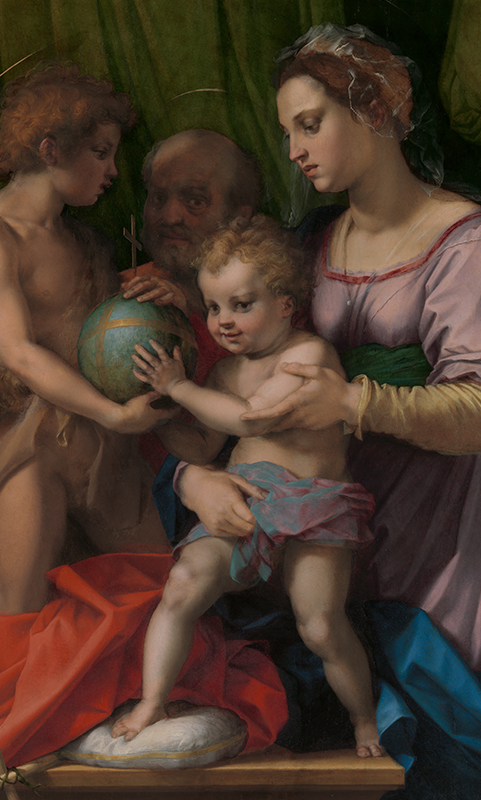
The Borgherini Holy Family, 1528-29
(Metropolitan Museum of Art)
By using infrared reflectography, conservators confirmed that a smaller version of The Holy Family  was  partially painted underneath Charity. This exhibit is a perfect continuation of understanding the artist's working process. If the Frick exhibit visualizes the preliminary stages of composition and singular details of a work, the exhibit at the Met displays the inception as well as the changes that can take place during the painting process. They also included a few pieces that belong to the tumultuous history of the city in the exhibit adding another dimension to the relevance of these paintings beyond their artistic value. Along with a late private devotional Madonna and Child from the museum's collection included were a Book of Revelations and the bronze metal of Girolamo Savonarola, the Dominican friar who was personally involved in the Republican government of 1494 after the expulsion of the Medici, a late 15th century woven silk polychrome velvet with a variation on a Medici emblem and this lapis lazuli cameo of Cosimo de' Medici, the Duke of Florence and Grand Duke of Tuscany.

Grand Ducal Workshop, Cosimo de' Medici (1519-1574),
Duke of Florence and Grand Duke of Tuscany,
ca. 1567-69
(The Metropolitan Museum of Art)
Except for Charity, on loan from the National Gallery of Art in Washington DC, the Metropolitan Museum's exhibit curated from pieces from their own collection, comes together succinctly to complement the Andrea del Sarto: The Renaissance Workshop in Action  at the Frick Collection. It is possible to access the works on display at the Metropolitan Museum of Art's website . I strongly urge all to download and closely inspect the exquisite Borgherini Holy Family.

Both the shows end on January 10th and this would be the perfect way to start the new year... with art and magnificence!


Sunday, August 16, 2015

Art, Engagement and the Renaissance


I have always loved art history, for the stories a work of art can tell us of its time, place and the people who lived at that particular point in history. Although I note the formal elements of a work, I am more interested in engagement with art on a personal level- how does it make me feel, think, understand. I had a particularly profound experience in a museum this June that touched on all these elements of engagement and more...


I caught the Sculpture in the Age of Donatello: Renaissance Masterpieces from the Florence Cathedral at the Museum of Biblical Art in New York on the last day of the exhibit, the last day of the museum, as a matter of fact.  I came to the show to see masterpieces that had never before left Italy in a totally new setting (it would have been sacrilegious for me to not visit such greatness when it was at my doorstep) but left with a new awareness of the greatness of the Renaissance.


Monday, September 22, 2014

From Marble to Flesh: The Biography of Michelangelo's David


The possibilities for a work of art to charm and fascinate lovers of art seem to be infinite. When the said work of art is Michelangelo's world renowned David, everyone is ready to be enraptured. But what is it about this particular scuplture as opposed to thousands of others that sets it apart? How has David become so well recognized and embraced by everyone from Renaissance scholars to tattoo artists?  How can a 16th century sculpture of a Biblical figure manage to be an icon of perseverance against terrorism, health and body image issues, as well as the environment, all at the same time?


Michelangelo, David, 1504
"David von Michelangelo" by Rico Heil
 @Wikimedia Commons
Joaquim Cruz,
Tattoo of Michelangelo's David, 2011
Pintrest @Tattoo Power 


A. Victor Coonin, in his book,  From Marble to Flesh:The Biography of Michelangelo's David, provides a comprehensive context for the great masterpiece, from its inception to afterlife in many forms and spaces. After reading this book the reader will not only understand how the David came into being, but also the relevance of the time period it was created in and its significance throughout the centuries. Coonin has written a book for the masses filled with great art historical details that can appeal to a wide audience. The narrative flows easily and naturally.  The reader is taken on a journey that starts with the birth of the idea for the decoration of the Cathedral of Florence, Santa Maria del Fiore, through the lives and careers of the different artists who were commissioned to produce prophets for the facade of the Cathedral, quarrying of the marble that was to become David, all before the genius to carve it was even born.

We tend to associate the David with perfection but the marble it was carved from was far from it. Even the story of the marble itself and the culture surrounding quarrying of marble, from the mountains that produced it to its eventual transport from the mountainside to Florence has been conveyed with great detail.  According to Victor Coonin "the simple reason why this imperfect block from Fantiscritti became the great David is that it did something that no such other block had done since antiquity. It allowed itself to be successfully cut from its mountainside womb."1

Each stage in the life of the David seems to have been a point of contention between different officials, artists, critics, the public.  Where David should be placed, who owned it, how it should be moved, what it should stand on? Names of the individuals involved at each stage of the project, official documents, contracts included to frame the timeline, grounds this work in scholarly research while making it easily accessible not only to art historians but to everyone. By providing historical background on David's different 'homes', Coonin takes the reader on an art historical journey through the most important sites in Florence. In the final chapter of From Marble to Flesh: the last section"Cloning the David through the 21st Century and Beyond" brings the story of David to our present day.


Serkan Ozkaya, David (inspired by Michelangelo), Louisville, 2012(Photo by Jae Grady)
I read the eBook version and found one of the advantageous was the ease with which one can move back and forth between the text and the citations.  Coonin has included drawings, historical photographs and prints for the reader to be able to visualize the historical events, places as well as the many angles and forms of the David. It was fascinating to learn that one of the largest replica's of David, a golden fiberglass copy twice the size of the original was created in Turkey by the artist Serkan Ozkaya. 2

I really enjoyed From Marble to Flesh: The Biography of Michelangelo's David and would recommend it to anyone interested in art or history.  I want to thank Alexandra Korey and The Florentine Press for providing a review copy of this book.


1 A. Victor Coonin, From Marble to Flesh: The Biography of Michelangelo's David, (Florence: The Florentine Press, 2014) 56, ePub for iBooks
2 Ibid., p. 300

Thursday, April 3, 2014

Image of the "El Turco" in Quattrocento Italy


Pinturicchio, St Catherine's Disputation, 1492-94
(Sala dei Santi of the Borgia Apartments, Vatican)
"I am not Italian, I am not an art historian, a student or even an academic and I am not even Christian! How many Turks do you see running around Italy, blogging about galleries and churches full of Madonnas and Saints... none! For years something in me searched for a way to connect with others. I found it in art and particularly in the faces and graceful poses of one particular artist whose works seemed to call me to action." 
                                                                                               -  Hasan Niyazi 
That artist was of course, Raphael, which is why we are honoring Hasan's memory and the light he brought to our lives on Raphael's birthday, April 6, 2014. Hasan connected, inspired, impelled so many of us to stretch the boundaries of our potential, vision and purpose, making us see what was right in front of us in a whole new way... today we are doing our best to continue the conversation that was so abruptly interrupted on October 28, 2013. This post will be part of a virtual collaboration, #raphaelhasan, celebrating the life of Hasan Niyazi.

Here are a few images of "El Turco" standing around in Italy.

Standing Man,  Workshop of Gentile Bellini,
(late fifteenth century)
(Stadelsches Kunstinstitut, Frankfurt)
After his famous expedition to Istanbul which resulted in the most widely recognized likeness of an Ottoman Sultan, Gentile Bellini is cited as being one of the most credible sources for the Oriental mode in Venetian painting. The conquest of Constantinople by Sultan Mehmet II in 1453 brought Europe in direct contact with the Ottoman Turks arousing great interest in the customs and manner of dress of these "Orientals." Bellini was not the only source of information however, visiting merchants and the ambassadors also provided the Venetians with eyewitness accounts. Generally accepted as the work of Gentile Bellini, the several drawings of Turks which have been attributed to Costanza Ferrara by Julian Raby, do seem to be quite authentic in their costumes and visage.[1]

Procession in the Piazza San Marco, Gentile Bellini, 1496
(Galleria dell'academia, Venice) 
There are many legends regarding Sultan Mehmet II's library and collections with its priceless Bibles, Torahs along with precious Qurans, antique and Persian manuscripts. Philippe de Montebello has even claimed Mehmed II's collection as the first Universal Museum.[2]  One of the most intriguing items allegedly displayed there was a Madonna and Child in front of which Mehmet kept candles burning. Bellini was commissioned to paint a manuscript illumination of the Madonna and Child as well as frescoes for one of the four pavilions Mehmet II was building inside his new palace compound. Unfortunately, only the Persian Pavilion survives to our present day as the Tiled Kiosk on the grounds of the Archaeological Museum. 

Pinturicchio, The Martyrdom of Saint Sebastian, 1492-94
(Sala dei Santi of the Borgia Apartments, Vatican)
Seated Janissary, Gentile Bellini 1479-81
(British Museum)
Styling himself as the new Alexander the Great, it has been suggested that Mehmet II invited Bellini into his household and intimate circle, emulating Alexander's relationship with his favorite artist, Apelles. After spending a year in the Sultan's household, Gentile Bellini returned to Venice bearing gifts: the most precious of these were a gold medallion and chain, a letter bearing the Sultan's Tugra, commending Bellini, and a Knighthood of the Golden Spur. Bellini's impressions from his trip to exotic Istanbul has been noted in two of his paintings, in some minor architectural details of Saint Mark Preaching in Alexandria and three turbaned figures in the background of the Procession in the Piazza San Marco which are thought to be the inspiration for Durer's drawing Three Standing Orientals.

Pope Pius II in the Port of Ancona, Pinturicchio, 1505-07
(Piccolomini Library, Siena)
By the sixteenth-century the Turk had become a familiar and accurately depicted figure in Italian art. Some of the best examples of this trend can be found in the frescoes Pinturicchio painted for Sala dei Santi in the Borgia Apartments in the Vatican Palace where he used Bellini's Standing Man and Standing Turk exactly as they appear in his drawings; meanwhile The Seated Janissary can be seen in his Martyrdom of Saint Sebastian.  Finally, in Pinturicchio's fresco of Pope Pius II in the Port of Ancona (while embarking on a Crusade), the figure of the standing Turk (at the far right) has been identified as Cem Sultan, Mehmed II's younger son who was a hostage and eventually died at the papal court.

The Seated Scribe, Gentile Bellini, 1479-80
(Isabella Stewart Gardner Museum, Boston)

The Seated Scribe representing an imperial page, probably like the ones Bellini encountered daily in the palace, after some debate has been attributed to Gentile Bellini. It is a pen in brown ink drawing which has been painted using water color and gold on paper. The method of production as well as the coloring has been noted as responding to the Islamic influence the artist had been exposed to in Mehmet's court.  I like to think of this particular drawing as the visual manifestation of the confluence of ideas and traditions between east and west for a brief moment in time.

Europe and the Ottoman Turks lived together as neighbors, rivals and trading partners for four more centuries, the changing political conditions dictating how each saw and represented the other. According to Giovanni-Maria Angiolello, after Mehmet's death, his son and successor, Beyazit II had his father's portrait along with other Western paintings sold in the Bazaar where they were acquired by Venetian merchants. The works Gentile Bellini produced in Istanbul, disposed of in such a hasty fashion went on to become sources of inspiration for European artists for many centuries to come.

[1] Julian Raby, Venice, Durer and the Oriental Mode, Islamic Art Publications, 1982
[2] Philippe de Montebello, Whose Culture? The Promise of Museums and the Debate over Antiquities, "And What Do You Propose Should be Done with Those Objects?"Princeton UP, Princeton, 2009

Sources

Caroline Campbell, Alan Chong, Deborah Howar, J. M rogers, and Sylvia Auld, Bellini and the East, London: National Gallery, 2006

Stefano Carboni, Venice and the Islamic World, 828-1797, New Haven, CT: Yale UP, 2007

Julian Raby, Venice, Durer and the Oriental Mode, Islamic Art Publications, 1982

James B. Cuno, Whose Culture? The Promise of Museums and the Debate over Antiquities, Princeton UP, Princeton, 2009

Tuesday, April 2, 2013

From Duccio to Ai Weiwei: The Multiple Lives of the Work of Art

Antonio, Allegri da Correggio, Leda and the Swan, around 1532
(Gemaldegalerie, Berlin) 
At a time when the sculptures and artifacts which have made their way to some of the finest institutions in the West are crying to be reunited with their country of origins, and the dealings behind these acquisitions are coming into daylight, I had the privilege of attending a lecture which presented the other side of the proverbial coin.  Philippe de Montebello, a legend in his own right, with numerous awards and honors including two Presidential medals and a Legion d'Honor, gave a riveting lecture, "The Multiple Lives of the Work of Art" at the Getty Museum in Los Angeles two weeks ago. His prose was captivating with interesting details and most surprising of all, a sense of humor. Although this should not come as a surprise, when Philippe de Montebello speaks, people stop and listen. Since this post concerns the lecture and not my personal views, I will try not to offer my own perspective, for now.

Sunday, November 25, 2012

Queen Elizabeth I to Sultan Murad III - Imperial Imagery


att. George Gower, Queen Elizabeth I, 1588
(National Portrait Gallery, London) 
This portrait of Queen Elizabeth I painted in honor of the biggest victory of her reign over the Spanish Armada of 1588 brings back a distant memory of standing in the middle of the National Portrait Gallery, listening to my niece relaying the story of having to count the pearls on the queen's dress for a school assignment. While we stood before the life-size portrait of 'Bess', admiring the elaborate treatment of the surfaces and observing her intrinsic features, I realized we did not have any equivalent to this, from our own history except for the one portrait, The Sultan Mehmed II, by Gentile Bellini.  In an earlier post, I had discussed the mobility of artists, influences and ideas as well as works of art in the fifteenth-century in regards to Mehmed II.  However, after Mehmed's death, commissions for portraiture in the Italian Quattrocento tradition seems to completely disappear from the Ottoman court.  The common belief that this was due to the religious inclinations of Bayezid II seems to be unanimous.  As a consequence of this, instead of portrait galleries full of life-size, oil on canvas likenesses of the Ottoman Sultans, Topkapi Palace museum contains folios full of manuscript illuminations with depictions in the Ottoman tradition.  What I want to discuss here is where the images for the Sultan portraits in these manuscripts came from if no known likenesses existed?

Friday, October 5, 2012

The Renaissance Portraits from the Courts of Italy to the Ottoman Empire

Gentile Bellini, The Sultan Mehmet II, 1480
(National Gallery, London)

"Bellini portrayed Sultan Mehmed from life so well, that it was considered a miracle."
                                                                                                      - Giorgio Vasari

Of all the genres in the history of art, portraiture has a very special place due to its intimate nature of enabling vis-a-vis encounters with illustrious figures from the past.  The Renaissance Portrait from Donatello to Bellini exhibit at the Metropolitan Museum of Art earlier this year was a great example of the art of depicting likenesses transcending centuries and making the absent present more than five hundred years after the portraits had been made. One of the highlights of the exhibit was the gallery devoted to portrait medals featuring primarily the works by Antonio Pisanello who is ascribed as the inventor of the portrait medal in Quattrocento. The portrait medal that was utilized by rulers of the Italian Renaissance to cultivate their image pertaining to their right to rule, lineage and intellectual capacity is a fascinating symbol of the philosophy of the the time.  It also is a great testament to the mobility of artists, ideas and influences as well as works of art - all of which can be garnered from examining Pisanello's body of work and it's effects as it pertains to the portrait medal. This mobility and influence seems to have extended out to the most eastern reaches of Europe, to a land that was ruled by Turks, the Ottoman Empire.

Antonio Pisanello,
Studies of Emperor John VIII Palaeologus and Members of the Greek Delegation to the Council of Ferrara and Florence, 1438-39
(Musee du Louvre, Paris)

In the absence of sources as to the artist or real intent of a work of art, most of the conclusions made have to be based on conjecture but following the visual clues that have survived enables even a novice a fascinating view into an enchanting period in history. I assume the best way to embark upon such a journey should be chronologically.  The medallion, John VIII Palaeologus by Pisanello is accepted as the first Renaissance portrait medal which was supposed to have been cast on the occasion of the Byzantine emperor's visit to Ferrara for the council to reunite the Eastern and Western Churches. The Eastern delegation is said to have really fascinated the Italians with their colorful costumes and interesting ways (the Emperor was out hunting instead of sitting in on the meetings) inspiring Pisanello to make the detailed drawings seen above.

Friday, September 14, 2012

Michelle Obama, The Queen of Cyprus, Eleonora of Aragon and Isotta degli Atti - what could they possibly have in common?

Andrea Mantegna, The Meeting  Camera degli Sposi, the Ducal Palace, Mantua,1471-74 
"All the world's a stage and all the men and women merely players."
The last week of August and the first in September, the American political world was on stage and the Republican and Democrats were merely the players.  While I am the least political person, I do make exceptions for big events such as these. Besides, my brother, Cenk was hosting the coverage of both the conventions on Current TV so we had no choice but to watch the full four hours even if it was just out of family loyalty.  While I gave only half my attention to most of the speeches, I listened with apt attention when Ann Romney at the Republican and Michelle Obama at the Democratic Convention took the stage.  These ladies were on a mission to paint a more human, personal picture of their husbands for the delegates and the American public as compassionate, loving individuals.  They were taking their part in creating their husband's public image.  Even I was impressed with Michele Obama's amazing speech (Link)  and I couldn't help but compare the image of the powerful (in every sense of the word) First Lady with those of others from the past.

Andrea Mantegna, The Court of Mantua Camera degli Sposi, the Ducal Palace, Mantua,1471-74
(Ludovico II Gonzaga with his wife Barbara von Brandenburg)

At this time, I was working on my book review (Link) for 3PP on the exhibition catalog for The Renaissance Portrait from Donatello to Bellini, an exhibition at the Metropolitan Museum of Art which contained portrayals of some of the most prominent individuals from fifteenth-century Renaissance.  In contrast to the image both the first lady and Mrs. Romney portrayed of their husbands as being 'regular guys', who could understand the American people, magnificence was the attribute that was largely cultivated during the Renaissance.  Especially the highly idealized female portrait with elaborate costumes and costly jewels was a greatly utilized tool to promote the persona and the status of their husbands.  While the rights and role of women is still being manipulated in our present day political arena, I thought we might take a look at some other consorts as well as leaders from fifteenth-century Renaissance to see what kind of an image they cultivated to further their cause.

Tuesday, August 23, 2011

Here's Looking At Me: Sofonisba Anguissola and the Problem of the Woman Artist

Sofonisba Anguissola, Bernardino Campi Painting Sofonisba Anguissola,
I have been very remiss in writing new posts this summer, not for a lack of new material but for not having enough time. I did write a guest post on one of my favorite blogs though. Thanks to H. Niyazi and his blog http://www.3pipe.net/ I am adding a profound amount of fascinating knowledge about the Renaissance to my studies of art history.  Sofonisba Aunguissola was a rare and a fascinating figure - a woman artist in 16th century Italy - and  I hope to write about her work at a later date. But for now, please check out the post...
http://www.3pipe.net/2011/07/sofonisba-anguissola-and-problem-of.html


Related Posts Plugin for WordPress, Blogger...