Showing posts with label Recipe. Show all posts

Friday, August 20, 2010

End of Another Journey...


My trip to visit my brother's family is almost over... I go back to New Jersey, my real life, tomorrow.  I have been here for nine days and I don't know where the time has gone.  Basically I spent most of my time sitting at home and watching my nephew while he slept, fed and p...ed.  This whole week has had a very calming effect on me; previously, I never would've believed that I could've sat still without any major activity for this long.  This has been the antidote to my hectic, boisterous summer in Bodrum but the predominant essence underlying both trips have been the element of family, connecting and creating memories.  I will probably treasure this week among the most precious in my life, the week I spent bonding with my newborn nephew.

Another great coincidence was Cenk's absence due to business in New York; Wendy and I had a wonderful time at home taking care of the baby, outside taking the baby on our daily outings to the Grove or the museum.  As it turns out, Cenk and Wendy's apartment is five minutes from the Los Angeles County Museum of Art, otherwise known as LACMA.  This was an opportunity I couldn't pass up even in my most serene state of mind.  Most people who know me wouldn't be surprised that I found my way either to the museum itself or to the park surrounding it at least four to five times this past week.  It was inevitable...


We did get the opportunity to spend one Saturday with Cenk before he left and it ended up being a lovely day that began with breakfast at home and then later on a trip to the Grove, an outdoor shopping center located next to the Farmer's Market, which is almost across the street from their apartment complex.


The Grove was delightful; we sat outside by the fountain at 'the Farm of Beverly Hills'.  The coffee was great and the light fare we enjoyed was delicious.  Cenk opted for a cheese plate, I had Huevos Rancheros, basted eggs on a crisp corn tortilla with a ranchero sauce topped with cheese and avocado and Wendy had chicken fingers - her classic choice for this particular restaurant, I am told. 


I concluded my meal with a piece of cheese and some candied pecans and caramelized pears from Cenk's Cheese Plate.

This was my colorful 'Huevos Rancheros' which was innovative and surprising.


The Farm of Bevelry Hills at the Grove
189 the Grove Drive
Los Angeles, CA 90036
(323) 525-1699

For Cenk's last dinner before he left, I prepared some of his favorites including 'Torn Borek with Cheese' which is  sort of a Turkish version of a cheese soufflé.  This was very impressive when it came out of the oven and they told me it tasted as good as it looked; I had to be satisfied with their declaration since I couldn't judge for myself (it is definitely not gluten-free.)


 'Torn Borek with Cheese'
6 Flour Tortillas Shredded into small pieces
5 beaten eggs 
1 cup milk
2 cups shredded cheese (Mozarella or Mixed Mexican Cheese)
1/4 cup melted margarine

Mix all ingredients together and pour in a greased oven proof dish.  Leave in the refrigerator overnight.  Bake in 350 degree oven for about one hour. Serve immediately.

For this past week, I played the part of the elderly aunt come to help out... I don't know when my life changed so much or when I changed so much that I am happy and content in this role.  I am still surprised at myself and haven't quite figured out the reason for this transformation... or maybe I have... That sweet smell, those trusting, smiling eyes, those heart melting cooing sounds... there is almost nothing I won't do, no role I am not willing to play to be able to hold him as he sleeps peacefully in my arms.


Sunday, July 25, 2010

My Solution for an Empty Nest Syndrome.

I woke up feeling a little bereft this morning.  Both the boys were gone, Hasan had returned to New Jersey last week, Murat had left on a sailing trip for a week...it was just my husband, my mother-in-law, Bostan and I left in the house...  and today was Hasan's birthday too... So what do we do now, I asked myself, even before I got out of bed...  Since I was the first one out of bed, I moped around for a bit waiting for everyone to wake up. After a while I started to plan our breakfast, my brilliant solution to a mellow mood...  I would make eggs... something a little creative, maybe... Then my husband woke up and I asked him how he would like his eggs, his  response was 'Menemen' not at all surprising since this is his usual response to this question nine times out of ten.  'Menemen' is a Turkish invention that can be eaten for breakfast or for a meal since it is made with tomatoes and peppers and even at times, onions.  I am not sure if there is any one set recipe, as long as you add tomatoes and eggs.  I just go by whatever I have on hand at the moment or however the mood strikes me.  Here are the general guidelines:


'Menemen' (Eggs with tomatoes)

Olive oil
Eggs
Tomatoes
Peppers (Red or green)
Onion (Optional)
Parsley (Optional)
Cheese (Feta- Optional)
Salt and Pepper to taste

The following is how I prepared the eggs in the picture... you have free reign... go wild...

1.  I put 1 Tbspn of olive oil and 1 Tbspn vegetable oil in a pan and
2.  sautéd the diced red peppers  (1 big pepper)  meanwhile
3.  I put two big tomatoes in boiling water for two minutes (this will help to peel them very, very easily), took  them out, peeled and diced them;
4.  threw the tomatoes into the pan as well, keep on sautéing on low heat, till the liquid had evaporated from the tomatoes and only the oil was left with the vegetables in the pan - this takes about 10-15 minutes.
5.  I made little indentations in the tomato mixture and broke 5 whole eggs and 2 egg yolks into this.
6.  Closed the lid for a little bit and let it cook.
7.  I checked after a couple of minutes to see if the egg whites had started to cook- from now on everything depends on your taste- we don't like our eggs to be cooked too much so
8. when the eggs whites started look like they had started to set (Turned a white color from the clear liquid) I put my 1/2 cup of shredded feta cheese in at this point and cook until the cheese has melted,
9.  add the 2 Tbspn of chopped parsley and keep it on the heat for another minute and serve.

Afiyet Olsun...
Bon Apetite...

Note: If you want to add onions, add them with the peppers and cook them until they turn yellow.  You can use any kind of cheese but feta is the best suited one in my opinion.
Be forewarned, you will consume lots and lots of bread with this meal.  The best would be Turkish bread, of course, but a baguette or a sour dough will do fine as well.

Saturday, July 17, 2010

'Corbada Benimde Tuzum Olsun' (Let there be some salt from me in the soup as well)

Bodrum, Turkey
In order to attain your dreams, life coaches tell you to visualize them in detail first.  I was never successful in doing this, until I saw a tiny scene in the movie, ‘Munich’, the exact picture of the life I would like in my future. A huge Parisian family was gathered together on their grandparents' farm in Provence and they were about to sit to eat the meal they had prepared.  Everything in this scene, from the quaint farm house to the huge kitchen to the kids running around amongst the flower gardens and of course the table surrounded by the sons and daughters and their spouses, their children looked exactly like something that I might have created in my mind.  Interestingly enough, when my son, Hasan, and I were discussing where we would be in the future, he mentioned this exact scene from the movie and said that this is how he visualized my future as well.  I guess it fit somehow. 


There is something reverent about a family gathered together around a dinner table that surpasses any cultural or generational boundaries.  Sharing a meal is something that brings us together and gives us more insight about each other even when there are other barriers present.  So, nothing gives me more pleasure than to prepare a meal to share with my family.  My husband and I, being aficionados of this concept have brought meal preparation to a new level.  We, usually, as a family (if we can cajole the boys into it), start by going to gather the best and freshest ingredients; around here this means to go to the weekly bazaar to buy our vegetables.  The appeal of the vegetables will usually be the deciding factor in what we will be cooking that week. 

 I bought lovely green peppers, fresh mint and sweet cucumbers in the bazaar this week which was the start for our preparations for our meal last night.  Since I always keep ground meat in the freezer and all the other ingredients are the basic staples of our kitchen pantry, ‘Dolma’ is the easiest of meals to prepare as soon as you buy the vegetables.  When I am in Turkey, I usually get my ground meat a mix of 20% lamb to 80% beef (it’s sometimes harder to find ground lamb in supermarkets in the US so we settle for using a fattier beef instead); in the past, no self-respecting Ottoman cook would use anything but all lamb, ground only once, for this dish.  Just like in a good hamburger, the meat in a ‘Dolma’ should not be ground or handled too much during mixing, lest it loses its flavor.    And of course, we cannot forget the magic ingredient, ‘Nar Eksisi’ (Pomegranante Sour.) I found a great one here in the market, Kemal Kukrer brand that is a little bit more expensive than the others but it is made from pure pomegranate concentrate and no additives – definitely worth it. 

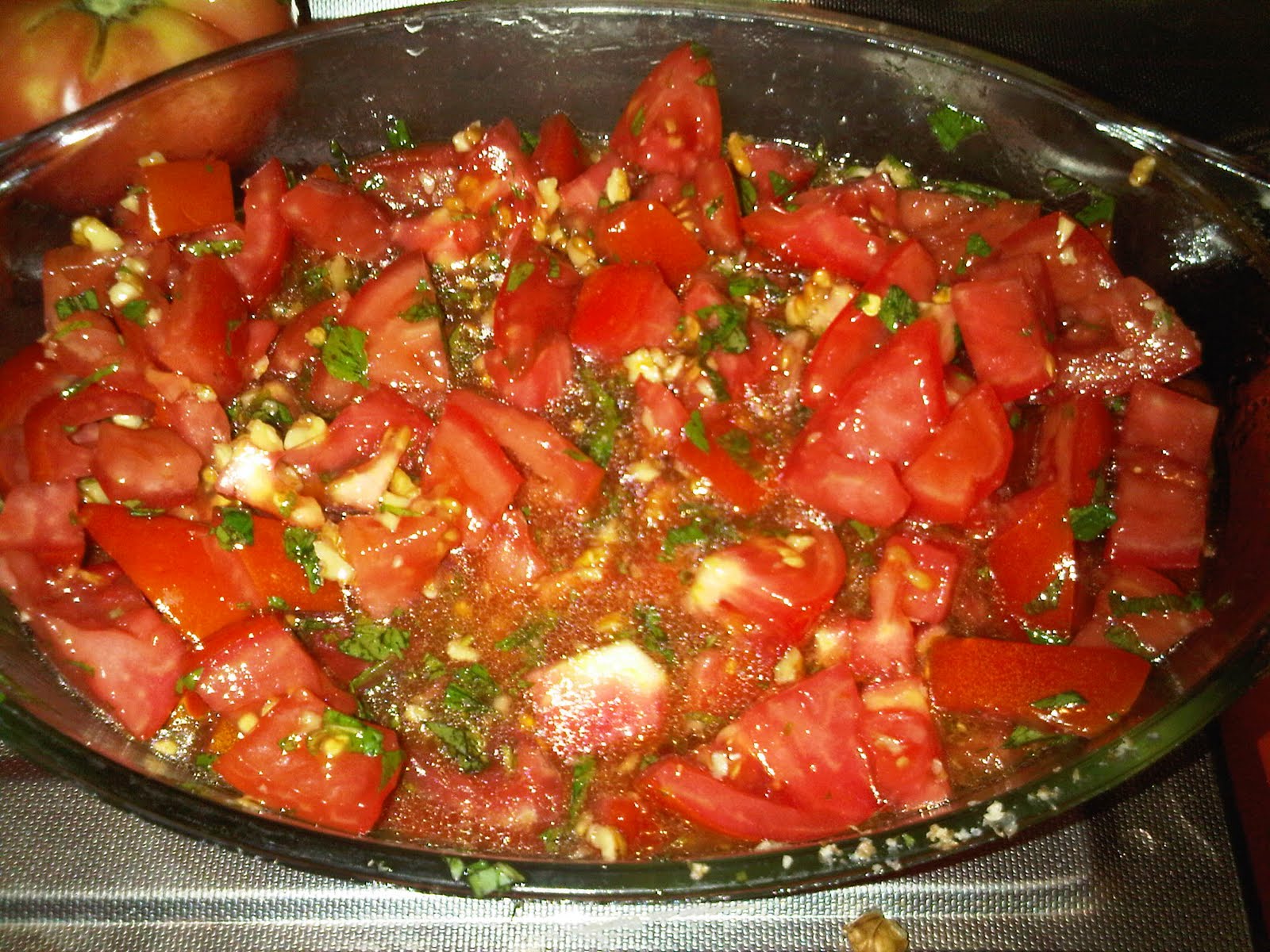
After I tasted the ‘Nar Eksisi’, I got so excited that I decided to make a salad I had learnt from my friend who visited Adana.  She told me that this salad, that is the simplest and the most savory dish that appeals to my taste buds like not much else can, was eaten in all the restaurants in Adana.  My husband is skeptical about this claim since there are no onions in it; Adana kitchen like most Southeastern Anatolian kitchens is very fond of onions- so he may be right, but I prefer it this way.  It’s both easy to prepare and very tasty.  It is basically chopped tomatoes, chopped fresh mint leaves, finely chopped walnuts and salt, oil and pomegranate sour to taste, mixed together.  It has a sweet and sour taste that is like nothing else. 

Yogurt goes really well with most Turkish home cooked meals.  We traditionally prefer to eat our yogurt salty; it is something found either on its own or in a variety of ways on the Turkish table.  ‘Cacik’ is a cold yogurt soup that is made by combining cucumbers cut into tiny pieces and beaten yogurt that is mixed with salt, dried mint and garlic, and drizzled with olive oil.  This is a perfect summer side dish.  Of course it goes perfectly with ‘Dolma’ and took its place on our dinner table as well. 

We have a wonderful term in Turkish that would be very appropriate for all of us in this meal preparation, 'Benimde corbada tuzum olsun' (Let there be some salt from me in the soup as well) meaning let me be a part of the joint effort.  After Hasan, Murat and I went to the bazaar to buy the vegetables, my mother-in-law's helper, Bostan, my husband and I prepared this unpretentious meal for the family last night.  The boys were ravenous after coming home from working out and we all enjoyed an amazing meal, quite similar to most families' all across the country, prepared and consumed in our own style with passion and joy. 

Thursday, July 8, 2010

'Zeytinyagli Kerevizli, Portakal Sulu Pirasa' (Leeks with Celery cooked in Orange Juice)

2lbs Leeks sliced into 1" strips
2 Celery Roots (usually potatoes are used in this recipe but with celery this tastes very good) sliced
1 - 2  Carrots sliced
1 whole onion
1 Tablespoon rice
3/4 cup olive oil
1 teaspoon tomato paste
Juice of 2 Oranges
4 Lumps of sugar,  Salt

In a  saucepan layer the carrots, celery, leeks and the whole, peeled onion. Pour the olive oil and add the salt, sugar, tomato paste and the orange juice plus enough water to make 2 cups of water.  Turn the heat on high and when it boils turn it down.  After about 15 minutes add the rice; continue to cook for another 40 minutes.  Let it cool in its own saucepan.  Serve cool.

Sunday, July 4, 2010

The Recipe for my mother-in-law's 'Vanilla Pudding with Peaches and Graham Crackers'

200 gr Graham Crackers
3 boxes of Jell-O Sugar Free Vanilla Pudding
3 3/4 cups of Cold Milk
2lbs of Fresh Peaches Peeled and Sliced (you can substitute canned fruits for this but fresh is infinitely better)
Fruit juice to dip the cookies in to soften them

1.  Mix the cold milk with the pudding mix for two minutes, set aside.
2.  Put a little bit of the pudding at the bottom of your plate.
3.  Take the cookies one by one, dip them in juice in order to soften them and lay them side by side on the plate.
4.  After the whole plate is covered with the cookies (you can break them to fill in the empty spaces) lay down a thick layer of pudding.
5.  Cover the whole surface with the sliced peaches.
6.  Repeat steps 3 thorough 5 once again.
7.  You can sprinkle cinnamon or  shredded coconuts over it.
8.  Cool and serve
 

Tuesday, June 22, 2010

Dessert - Duygu's Muhallebi with Fruit Topping

I have a little confession to make, I completely muddled this recipe.  The 'Muhallebi' is the same as the one in 'Black and White Pudding' but my sister-in-law, Duygu, is incredibly inventive and she makes a wonderful fruit topping for this desert that is both fresh and mildly sweet.  I called her up and got the recipe for the topping but changing ingredients to fit my gluten-free diet destroyed it completely and the end result was something that was best gotten rid of very quickly.  I had already put it in my menu so, I just added fresh fruit to it.  I think the presentation was probably the best part of this desert.  I did put it in the freezer, though and am very curious of the outcome.

I wonder what Duygu would have done, if she was in my shoes, she is the queen of improvisation and I am sure that pudding would've turned into something truly wonderful.  She can turn healthy cooking into something to be savored; I am always amazed how delectable her everyday table is.  My sons even rave about her eggs.  I think, here, using the best and freshest ingredients is a key that goes hand in hand with creative and bold approaches.   I have never tasted better fruit than I have in her house.  Honestly, it drives me crazy, I don't know where she finds it all the time.  Whether it's in season or not, she manages to find the best.  She makes it all seem so effortless and easy too.  There is a lot I still have to learn from her...     

I am going to have to watch her make the topping next time I am in Istanbul and then I can post that here as well.  But for now, this will have to do...


Monday, June 21, 2010

Dessert - Beaten Muhallebi (Black and White Pudding)

My mother-in-law is a diabetic so, of course she thrives on chocolate and deserts.  Her most memorable signature dishes I can remember are all deserts, like this 'Muhallebi' or 'Bread Kadayif' or her Apricot Tart.

Although 'Muhallebi' (Turkish cooked pudding) is a very traditional Turkish desert, I think this recipe with its rich chocolate topping is a bit modern, but luscious, all the same.
Butter and sugar were my mother-in-law, Yezdos's, most favorite ingredients.  This pudding is almost solid thanks to the amount of butter it contains.

When I was a child, I loved the smell of browning flour in butter; unfortunately, in that state it only burns one's mouth, tongue, lips... without much taste to it; I know from first hand experiences.  When my mother-in-law made this 'Muhallebi' the whole house would be seeped with that wonderful smell and then when she added the warm milk to it, the sweet aromas rising from the pot would take me back to the days when I was a little girl waiting to lick the bottom of the bowl again.

The major trick to this 'Muhallebi' is that it is beaten for 20 minutes after it is cooked.  Then you have to cool it, preferably, overnight, so that when you pour the chocolate sauce over it, it will  become a separate level on top instead of mixing into the pudding underneath like mine came out that night (actually, I substituted rice flour for the wheat flour so it would be gluten-free but I think the proportion wasn't right)

When I saw that it hadn't set and it was going to be too runny, I just put it in the freezer and served it frozen... It actually came out alright, but the recipe that follows is for the real thing and it is just fabulous...  


Entrees - Vuslat's Spinach Borek

When I moved to Turkey and got married more than 20 years ago, I had no idea how inadequate I was in the kitchen until one fateful day I tried to cook a pot of pink beans in olive oil.  I had gotten the recipe from one of my newlywed friends who assured me it was sooo easy. She told me the basic ingredients, 1 kg of pink beans, 1/2 cup of olive oil, 2  onions diced, 1 potato and 1 carrot cubed, 2 cloves of garlic and tomato paste with 1 cup of water... these were suppose to be cooked on high until it boiled and then simmer for one hour.  After gathering my ingredients I was ready to tackle the project with gusto the next Saturday morning.  As a new bride, I was really excited about preparing my husband's favorite dish for him; it started out as a surprise but as the day progressed on and my telephone calls to my Aunt Vuslat got more and more frantic, he began to wonder what I was doing in the kitchen.

My maternal uncle's wife, Vuslat  is probably one of the most creative, talented, resourceful and expeditious individuals, in the kitchen that I know of.  She can create a feast in record time from the most humble of ingredients.  So, she was my natural choice to call for help in time of need.
The first call was probably around 10 in the morning and I asked her if these ingredients could possibly be right; I was looking into a huge pot full of beans with a few measly pieces of carrots and potatoes and 1 cup of water that was nowhere in sight.  My aunt assured me that it would be more than enough.  I kept on repeating that I couldn't see the water at the bottom of the pan but she said it was ok, that beans would cook quickly in about an hour and I didn't need to add any more water.
After my third phone call, an hour later, she let me add 1 more cup; I had given up on the other ingredients and just worried about making sure the beans would cook already.  I kept on staring into the pot full of beans, dubiously.
One hour turned into three and then five, six.... my huge pot of beans was getting more and more full of beans that were still hard as a rock.  By this time, my aunt was sitting by the phone waiting for my next phone call.  She kept on going over the ingredients with me and I assured her that I put in 1 kg but when I mentioned adding the whole bag, she realized what I had done.  The recipe was for fresh beans, taken out of their skins.... I had put in a whole kilogram of dried beans... without soaking them overnight... so instead of cooking, they were only expanding and expanding, while the rest of the ingredients had turned into burnt mush.

The most important lesson I derived from this experience was to make sure I got the right measurement  and ingredients for a recipe by any means possible.  I used to drill my aunt until she could not take it anymore to get any kind of a recipe out of her that I could reproduce myself.  After many hours of questioning, I derived my first formula for 'Borek' that turned out to be the golden recipe.

Borek is a wonderful Turkish pastry, that everyone absolutely loves, made of dough, eggs, milk and butter or oil with some kind of filling that is baked in the oven until it is golden brown.
For each layer of 'Yufka' (a Turkish dough that is thinner than a puff pastry but thicker than a phyllo dough, which can be found in Turkish grocers) I use one egg, 1/4 cup butter or oil and 1/4 cup milk.  The more you add the better it is, and believe me with this recipe, it is very very good... The fillings can vary from feta with parsley to cooked ground beef with onions, to mashed potatoes to any kind of vegetable combined with some kind of cheese, I could go on and on for hours.

You start by greasing your baking pan and then spreading your first yufka with the sides hanging out.  You mix the eggs, milk and butter or oil according to how many yufka's you are going to use and spread this mixture liberally, in between each layer of yufka, the general rule is 3 yufka's on the bottom of the pan then the filling and two yufka's on top and then the sides are wrapped on top of the whole thing with the remainder of the egg mixture poured over the top.  If you run out of the egg mixture before you get to the top, don't despair, just make some more... remember, in this instance more is better.  You put your pan in to a 350 degree oven for one hour and that's it.  One of the best parts of it is the wonderful aroma that fills the whole house as it is baking.

My Aunt's recipe for the raw Spinach filling is so delicious that I use left over filling as a salad, mixed with tomatoes, peppers and olives. Since the spinach, onions and feta cheese are mixed with olive oil, It already has the basic ingredients for a good salad.

'Boreks' can be made to eat for breakfast, with your afternoon tea as well as an appetizer or a light entree.  Over the years, I made so many boreks that I had to add a little variety and the borek I made for the night of the Global Dinner Party was in fact made by combining water and oil and spreading that on the yufka instead of the traditional egg mixture and at the end bathing the whole borek with the same water mixture and letting it sit for two hours in the refrigerator.  Before putting it in the oven I spread a beaten egg over the whole thing.  It would've been much better if it could have stayed in the refrigerator overnight since the more the yufka soaks the water mixture the lighter and fluffier it gets.

As I mentioned many times before, the main thing is to stay calm.  If there is too much water floating above the borek when you take it out of the refrigerator, you can pour some of it out, the same thing is true for when you take it out of the oven as well.  Sometimes, the top is bubbling with the water-oil mixture, I just pour it out before I serve it.
Afiyet Olsun. (Bon Appetit)

Salad I made with the left over filling the next day

Entrees - Pilav with Chickpeas

In Turkey, they say you can measure the expertise of a woman in the kitchen by the rice she makes.
Boy, did it take me a long, long, long time to get it right.  Even today, I still hang around the stove while making the rice and check regularly to see if it is done.  There are many variations of rice in Turkish cuisine, you can add peas and dillweed, or tomatoes or eggplant or meat or spices.  Every single region has a special kind of pilav of their own, each unique from the others.

I use medium grain Goya rice because it is the same as the rice we have in Turkey, the others tend to be more rigid and don't soften enough to our liking.  In a good 'Pilav' the rice is suppose to be soft and yet not sticky; every fork-full should consist of separate grains of shiny rice cooked to perfection.
I am told, you are not suppose to stir the rice often and only with a fork.  
My mother-in-law always says that the 'Pilav' would like the family to quarrel so that it can pull itself together.  It is a good idea to let it sit for at least 40 minutes.

I prefer the bottom crisp and brown, so I make it in a non-stick pan and let it stay on the heat a little bit longer after the water is completely evaporated. I then flip it onto a serving plate like a cake.  Another great option is to put the cooked chicken (since you are going to have it on hand after making the broth anyway) around the pilav and you can serve that as the main meal.


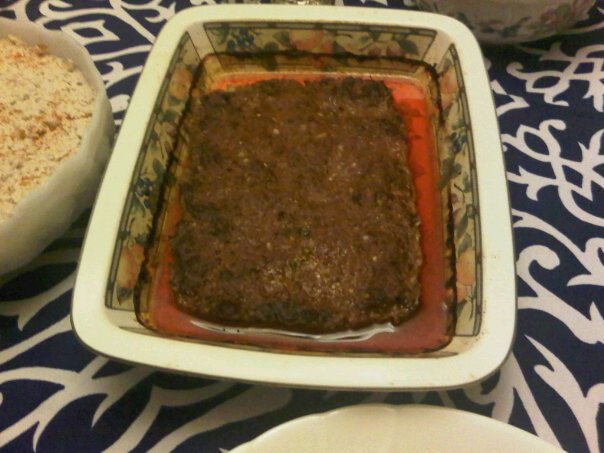
Entrees - Fallen Woman's Kebap (my Grandmother Ulker's recipe)

The first time I visited my parents' hometown, Kilis, a small border city in Southeastern Anatolia, I was about 9 or 10 years old.  My maternal grandparents still kept a house there at the time and it was one of the most incredible places I had ever seen.  You entered into an open courtyard that had the kitchen and several small rooms bordering it and a door to a small backyard, then there were stairs on the side wall that took you up to the family's living quarters.  I felt like I was in a fairy tale house, it was so different than the cement blocks that we called home back in Istanbul.  That trip was also the first time I tasted this kebap.  Southeastern Anatolia is the birth place of the 'Kebap' but it is usually made in restaurants with very fatty lamb.  I believe this must also be called a 'Kebap'  because the taste can be quite similar to the one's you can eat at restaurants with one little difference, it's a bit more healthier.     

My grandmother had prepared the meat that my grandfather had cooked in a breadbaker's special wood burning oven, next door.  I think I ate the whole thing.  My grandfather, then laughingly told me the name and the story of this wonderful delicacy.  It is called a 'Fallen Woman's Kebap' because a woman who is outside the home all day visiting, shopping or whatever else instead of cooking, cleaning and other wifely chores would of course be considered a fallen woman.  But she still had to feed her family and this is something you can put together in 5 minutes and throw in the oven and still make it for dinner time. I guess we could call it 'The Working Woman's Kebap' today but it wouldn't be as much fun...

Basically, you can use any type of ground meat you like (the original is beef) and put tomato paste, pepper paste, parsley, lots of diced onions, a couple of cloves of garlic, salt and pepper, knead it all together and pat it down in an oven-proof dish and cook for about 30 minutes in a 400 degree oven and... Voila!
I would suggest playing around with herbs and spices to get a taste you prefer but made this way it is a perfect 'kebap.'


Meze - Sabiha Hala's Kisir

I am going to have to admit Sabiha hala(Aunt) is one my most favorite people in this world.  She is currently 98 years old and just as entertaining and lively as she was many years ago.  Everyone from little kids to teenagers to even prickly adults enjoys her company and her house is always full to the rim with people visiting.   She used to be one of the finest cooks as well; society ladies' chef's used to ask her for advise on how to cook certain dishes.  She loved to eat and so she loved to cook.  One of my favorite stories growing up was about how she would get up in the middle of the night yearning for a certain desert and she would cook one portion just for herself right then and there.  My grandmother used to say some of my diligence when cooking for myself reminded her of my great aunt, which was high praise indeed.

Everything Sabiha hala made was great but her 'Kisir' (Cracked Wheat Salad) was the best I had ever had.  There are a lot of recipes and different variations for this particular dish but the 'nar eksisi' (pomegranate sauce) which I couldn't live without, a sweet and sour molasses-like liquid is the secret ingredient that makes it fabulous.   You can add more than the recipe to your own taste.  One summer, when I was visiting the States and couldn't find the 'nar eksisi' I substituted lemon and molasses which was an acceptable solution for the time being.  You can find this in Turkish grocery stores online.  I would definitely try to get it since it is a magical addition to any salad.  


Sunday, June 20, 2010

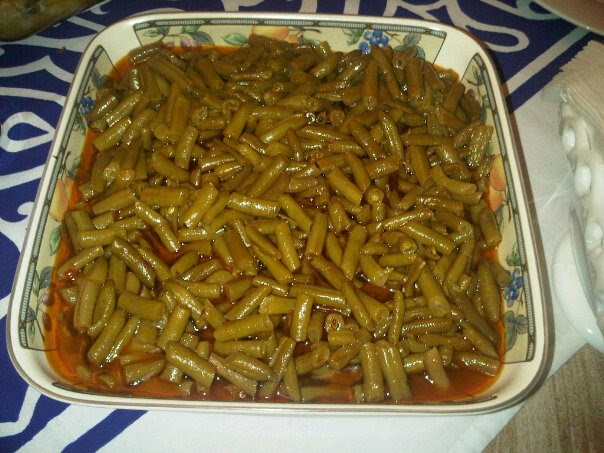
Meze - Tuku's Green Beans in Olive Oil

Olive Trees are in abundance on both sides of the Aegean sea, I think this is enough of an explanation for the variety of vegetable dishes in Turkish cuisine that are prepared using olive oil.  Almost all the vegetable can be cooked in olive oil using a basic recipe with minimal variations and the results are always scrumptious.  Olive oil dishes are one of the main categories of Turkish cooking. 

Turkey is a true mosaic of different cultures and civilizations, our own family is a perfect example of the different types of backgrounds that are inherent in our culture.  While my parents are both from Southeastern Anatolia, my husband's father was from Drama, a small town in today's Macedonia and  his mother's family was from Crete.
Although I didn't get a chance to meet her, my mother-in-laws mother was reportedly an excellent cook of all the 'Zeytinyagli' (olive oil dishes) and Tuku, our dear aunt, who lived with her had the privilege of learning her way of making these particularly Aegean dishes.  Tuku was one of the only women I know who had learnt to cook with measurements and basically, it is thanks to her that I started to cook any decent 'Zeytinyagli' dishes at all.  

The basic recipe I learnt from Tuku is as follows - for every kilogram of fresh vegetable, use 1/2 cup of olive oil, 1-2 onions, 1 tablespoon of salt, 2 tablespoons of sugar, about 1 cup of warm water and then you can add tomatoes or rice or lemon according to the vegetable you are cooking.  After all the ingredients are combined as they are suppose to be, you cook it on high until it starts to boil and then turn the heat down and let it simmer for an hour.  You are suppose to let the vegetable cool in its own pot before removing it to a serving dish.  All the olive oil dishes are served cool, with a little drizzle of olive oil on top, to make it look shiny.  


Meze - Aymis's Circassian Chicken

If some people are born with a green thumb, some are definitely born with a natural cook's hand and my sister-in-law, Duygu's mother, Aymis hanim is definitely one of those talented individuals.  Whatever she touches seems to turn into a gastronomical delight.  None of our special family gatherings at Duygu's house would be complete without her mother's incredible 'Zeytinyagli Dolma's' (stuffed grape leaves in olive oil) or 'Barbunya' (pink beans in olive oil), yummm...  'Dolma' is the one food that would separate the girls from the women in case of Turkish cooking, since it entails many hours of wrapping the rice and onion combination filling in thin grape leaves; the size and the firmness of the Dolma pronounces the expertise level of the preparer.  It is one of my favorite foods and I am especially fond of Aymis hanim's Dolma's.

Circassian chicken, 'Cerkez Tavugu,' is another specialty that is the sign of a good Turkish cook.  The actual recipe is suppose to be very hard because it requires extracting the oil of walnuts; I have never, even questioned, how that is done, so I cannot tell you but this recipe, in my opinion, tastes better than the real thing.  It is super easy and incredibly delicious.

Getting a recipe with actual measurements out of a real Turkish cook is next to impossible,  These women must have all learned how to make these delicacies on their mother's laps and are very easy going about giving out recipes since everyone's pinch or hand full is different; the resulting product can be extremely variable.  I have learned after many melt-downs that all you need to do is relax and trust your taste buds.  If you get the basic ingredients fresh and rightly prepared (in this case boiling the chicken until it is tender) the sky is the limit.
I am including the recipe for this but I have to admit that I start out with the boiled  chicken and keep on adding more and more yogurt and salt and even garlic until I get it to the consistency and taste I desire.


Meze - Nuko's Roasted Eggplant Salad

Mezes are tapas-like, small portions of food that is served to go along with the Turkish national drink ‘Raki.’ There is a whole ‘Raki Culture’ related to how the drink is to be consumed slowly, in accord with the food and the conversation. But most of the same foods that are used as mezes can also be found in any Turkish home, cooked as the appetizer or cold vegetable dish that is served before the main meal.

My mother, Nuko, before she became a businesswoman, used to be renowned for her splendid tables and endless hospitality; she spent many years feeding whoever walked in through our doors, sometimes to the point of detriment to the guests’ health. Insistence is the sign of a truly outstanding hostess in our culture. One time I heard my mother-in-law, boasting to my mother about how many people had to go to the emergency room after leaving her table, I have heard of at least one heart attack and one near-collapse, while Nuko responded with stories of her own.

She rarely has time to cook these days but, she still absolutely loves to roast eggplants. According to my mother, the messiest job that I have a major aversion to, is the easiest thing in the world and she is sure to have it on hand anytime she entertains. Since I too love the end result, I tackled my demons for this special evening and came through ok, I think. Once you roast the eggplant in the broiler of your oven, the rest is up to you and your preference.


Wednesday, June 16, 2010

Great Fresh Easy Pasta Recipe for Spring

http://video.nytimes.com/video/2010/06/11/dining/1247467644171/pasta-with-peas-prosciutto-and-lettuce.html
Related Posts Plugin for WordPress, Blogger...