 |
Gustave Caillebotte, Paris Street: Rainy Day, 1877
(The Art Institute of Chicago) |
Gustave Caillebotte has always been one of my favorite artists but since he does not have as big a body of work like some of the other Impressionists in the United States, it's not so easy to come across his paintings . I was really looking forward to seeing one of his most important works,
Paris Street; Rainy Day at the Art Institute of Chicago. Coming face to face with the original work reaffirmed the importance of seeing a work of art in person. This painting I was so familiar with and studied for my art history classes on many occasions, had the ability to surprise me and take my breath away. I wasn't prepared for it's monumental size - 83 1/2 x 108 3/4" or its dominating presence. Standing before it, at the entrance of the first gallery of Impressionist paintings, I was transformed to that moment, to that street corner in Paris in 1877.
Caillebotte has captured the transient moment perfectly in this canvas. He gives the viewer a wide angle view of the modern city with it's inhabitants from all walks of life coexisting within the newly built boulevards of Haussman's Paris. In the foreground is an upper class couple walking arm in arm, and there are a multitude of other passersby in the background but the sense of disconnect is prevalent in the picture. All the detached, non-communicative character of the figures occupying the intersection may indicate Caillebotte's disdain for the anonymous and anti-picturesque nature of Haussman's boulevards but also a place with a personal significance, since his family residence that included his studio was just a few blocks away.
1 Another typical aspect of Impressionist paintings that is present in
Paris Street; Rainy Day - this was probably the artist's own experience.
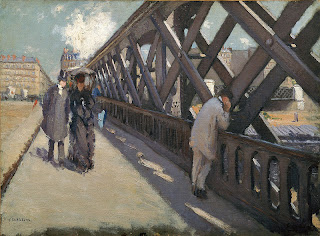 |
Gustave Caillebotte, Le Pont de l'Europe, 1876
(Musee du Petit Palais, Geneva) |
Caillebotte was fascinated with the idea of modernity causing a sense of isolation in urban centers and some of his works depict this desolate state of mind very clearly.
Le Pont de l'Europe is another great depiction of this psychological state. In
Paris Street; Rainy Day, the umbrellas seem to reinforce the sense of detachment giving each person their own space. No one is actually communicating with one another, they all seem to be in their own world. The bourgeois gentleman in the front seems to represent Baudelair's
flaneur, the exquisitely turned out, well mannered, gentleman stroller, detached observer.
Unlike most other Impressionists, especially Renoir or Monet, Caillebotte did not represent modernity by ignoring or blurring it but instead giving it a prominent position in his painting. The gas light in the very middle of his composition dividing the picture plane and the uniformly manufactured umbrellas, as well as the newly constructed, wide boulevards were all products of the industrial innovations of the time period.
Caillebotte's treatment of atmosphere and weather conditions also differs from his Impressionist colleagues. He has represented the rain by an overcast sky and manipulating different grays to represent the wet cobblestone street. It is not a matter of light reflections and broken brush strokes but highly finished elements in a very deliberately constructed perspective.
Caillebotte was a prolific artist whose style is found to be closer to the school of Realism due to his exacting technique and structured spatial compositions. He was known for his views of urban Paris as well as interiors with domestic, familial scenes. His interest in photography can be deciphered from the abrupt cropping of some of his compositions and the unusual perspective effects he uses may be due to his interest in Japanese prints.
Gustave Caillebotte was an independently wealthy artist as well as an avid art collector who supported the Impressionists by buying their work and helping to fund their exhibitions. He left his extensive art collection including some coveted masterpieces to the French government with the stipulation that they exhibit his Impressionist collection as well, which, today constitutes the core of the Musee d'Orsay collection of Impressionist paintings.
I feel
Paris Street; Rainy Day is one of the must-see attractions of Chicago. It is the perfect example of how a great work of art can draw the viewer in, try to understand the time period and contemplate what the artist was trying to get across.
1. Douglas W. Druick and Gloria Groom, The Age of French Impressionism, Masterpieces from the Art Institute of Chicago, 57


