Showing posts with label Realism. Show all posts

Monday, October 21, 2013

Edward Hopper Drawings at the Whitney and Engagement in Museums with Technology

Self-Portrait, 1945
Going to museums to view art is a lot of work these days involving a bevvy of options that are available to anyone with the right tools and a minimal understanding of social media. Which is why I was thinking about a post I had read in Daydream Tourist, "Why you can't take photos in museums?", while I was walking around the Hopper Drawing Exhibit at the Whitney Museum of Art two weeks ago. I was looking, thinking, tweeting and taking pictures... as well as remembering a time when all I had to be concerned with while visiting a museum was the audio-guide - if they had one available or not. Granted we didn't have user-friendly smartphones nor any kind of social media to post those photographs on back then, I couldn't help but be aware of all that I allowed to intrude into my private time with art today. What did I think of all of this at the end of the day is something we'll find out together by the end of this post...

Jo Hopper, 1945-50
My Mother, c. 1920


I have always found Hopper's work speaks to me like no other artist's, leaving me with an impression of familiarity where I could read into his works a story similar to my own on some level. So, I was really excited about viewing his drawings, hoping to get a glimpse into his creative process... and maybe even glean some insight into what made him tick?

Wednesday, March 2, 2011

Gustave Courbet - After Dinner at Ornans

Gustave Courbet, After Dinner at Ornans, 1848, 76 7/8 x 101 1/8

It was the month of November, Courbet and a group of his intimates are sitting around a table after dinner, listening to music, at his friend Cuenot's home in Ornans. Adolphe Marlet has come back from the hunt and is lighting his pipe while his dog sleeps under his chair, Promayet is playing the violin while Courbet and his father are sitting listening.  He has depicted life in the country, honest imagery of the lives of simple people... but on a grand scale. A non-moralizing genre scene, an actual event that he experienced.

This painting that was submitted to the Salon of 1848 was received with mixed responses, some even said Courbet was dragging art thorough the gutter... He still received a metal for it and made his fame in Paris.  Since he won an award, Courbet was able to exhibit his works without being judged on the next exhibit.

After this painting Courbet moved to Ornan to paint what is referred to as his 'breakthrough paintings'

Gustave Courbet - A Burial at Ornans.

Gustave Courbet, A Burial at Ornans, 1849-1850, approx. 10 1/2 x 22
A Burial at Ornans is a wonderful painting loaded with so many elements to make a statement and disturb the acceptable norms of mid 19th century France.  This painting was painted during a time when Courbet was living in Ornans where he painted his breakthrough pictures about the peasants and life in the country. (The Stonebreakers; A Burial at Ornans; Peasants of Flagey Returning from the Fair)   He was painting his experience in the countryside for submission into the official Salon, to be viewed by a city audience...  At this time there was an acceptable way Parisians wanted to see the countryside to fit in with their beliefs.  They expected to view a place of order, paintings of man in harmony with nature and representations of Catholic piety, a.k.a. people praying. 

One of the things that disturbed the critics the most was the fact that Courbet painted this enormous painting with the motifs and crowds of historical paintings about an insignificant subject, an unknown peasant's burial.  When looking at a painting of this size they expected to see a highly idealized, grand narrative. Instead Courbet gave them an everyday event, a group of peasants in black, standing around before a newly dug up grave prior to the burial. This was considered radical because instead of choosing the culminating moment of the actual ceremony, Courbet chose to focus on the moment before it took place, in turn making the viewer feel a part of it. 


Another problematic social issue was the concept of the burial ground.  At this time peasants didn't have formal burial grounds like this and people reacted to the idea of them deserving one. There is a figure in the foreground wearing teal, he would be the veteran of revolution of 1793 which is also problematic for middle and upper-middle classes because of his peasant and revolutionary associations and they also wouldn't want to acknowledge that peasants were key figures in the revolution.


In classical art, where everything was staged and balanced, viewers would know where to look since everything would be pointing to it. In this painting, however, there is a lot of confusion, dynamism and realism. This is how a real procession would look with everyone coming up, gathering around slowly and focusing on different directions. There is a circular crowd standing close together up front of the picture plane that Courbet snakes and makes harder to read.   

The issue of attention, who is looking at what, in which direction is very important. T.J. Clark terms this collective distraction when everyone is not focused on one point, they are all looking at different directions.

It is actually a very still painting, a serene scene with a mass of sombre bodies that is very hard to decipher from one another.  We can't really tell where one person ends and another begins with everyone in black.  He is shifting our attention off center with the use of the color white dispersed throughout the painting, in a sea of black. There are also two figures in red in the middle of the composition that catch your eye whose bodies seem to merge into one another with two heads looking at opposite directions.


A cross can be seen above the heads of the mourners and religious officials.  The figure of the Christ on a staff is being held by a gentleman with white gloves but it almost looks like a separate entity, up on the hilltop. Since this is a religious ceremony, religion has an importance here but at the same time, Courbet is undermining church authority. The figures in red are beadles, officials of the church, who assisted at religious functions, and upon closer inspection, they seem to have bulbous noses and red cheeks attesting to their state of drunkenness.  It would be very offensive to city viewers to see church officials not idealized but as they were. 


This isn't based on his actual experience but probably might be his uncle's burial in Ornans.  He was also going against what the other contemporary artists like Couture was doing and painting people in contemporary clothes.  The people who posed for him were people he knew from the town who attended the actual funeral. Two of the women are his mother and sister, his friend Bouchon, and maybe his grandfather,who was already dead.  He was not painting outside, en plein air, he had them pose for him in his studio. 

This was Courbet's first monumental painting he made in 1848 but didn't get to exhibit until1851.  It was received with mixed reviews but eventually as Courbet so aptly stated "The Burial at Ornans was in reality the burial of Romanticism." 

Tuesday, March 1, 2011

Back to Courbet and Realism

Gustave Courbet, The Stone Breakers, 1849, (Destroyed during WW II)
Gustave Courbet was the father of Realism, dominant artistic movement from 1840-1870, when Impressionism and Symbolism emerged.  Artists took the events of the day and represented them in their work.  Realism and reality are not the same, representing the sober facts taking place in contemporary life was a reaction to Romanticism which was trying to appeal to the imagination. 

Mid 19th century western Europe was becoming increasingly industrialized, urbanized and there was an emerging bourgeois. Courbet came from a farming family who lived off the land.  In fact his family owned property, multiple houses and was rising into the bourgeois but still lived off the land.  Courbet went against his father's wishes that he be a lawyer and moved to Paris to become an artist. He mostly taught himself to paint by studying the masterpieces at the Louvre. Before 1848 only three of his paintings were accepted in to the official Salon. His career opened with the Revolution of 1848 and closed with the Paris Commune of 1871.   He did not seem to participate in the Revolution of 1848 but he was a part of the Paris Commune of 1871 and was imprisoned for six months.
He actually benefited from the revolution of 1848 because the jury for the Salon was replaced with a group that included more contemporary artists, not just academicians. In 1848, 10 paintings and 1849, 11 of his paintings were exhibited at the Salon. 

Gustave Courbet felt painting should represent visible and tangible objects instead of idealized imagery.  He was interested in the present day and fate of the lower classes, classic as well as popular imagery.  

When in 1855 three of his paintings were refused by the Exposition Universelle, he mounted his own exhibition right next door and called it "On Realism."  The idea of rejecting the Salon and setting up his own tents near the Salon and presenting his own work is the first in avant-garde, artists who charge ahead of the official standards, leaders.

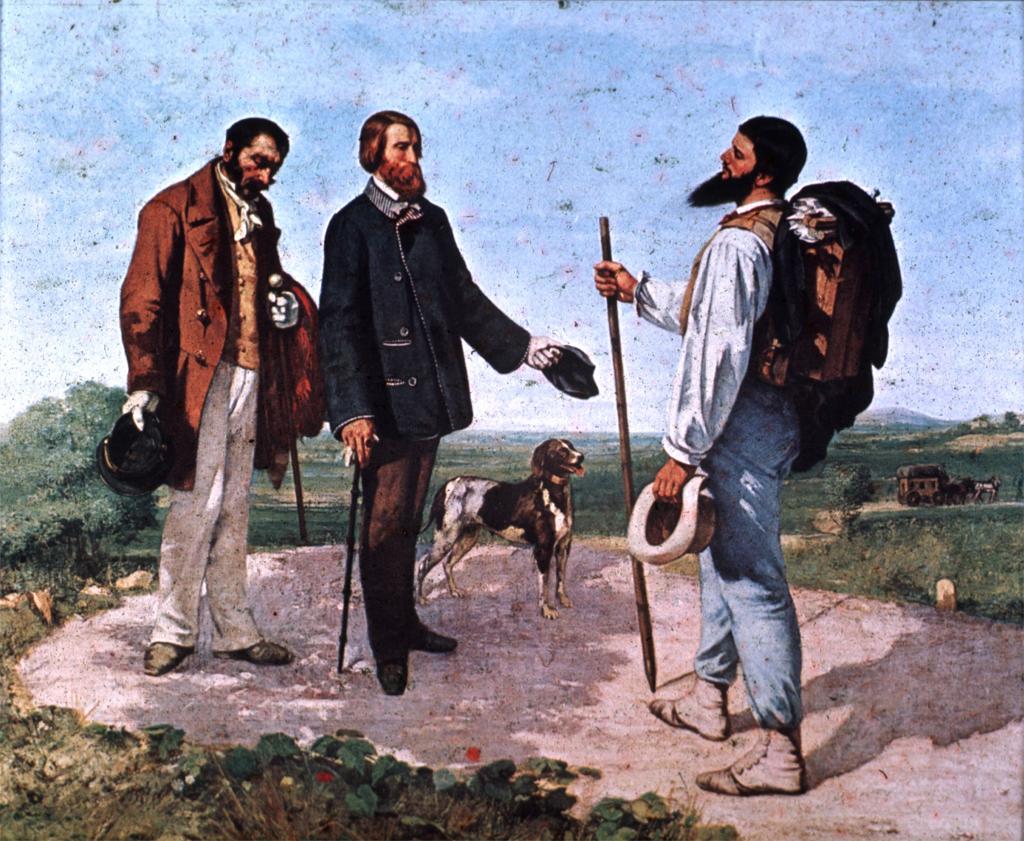
Gustave Courbet, The Meeting or Bonjour M. Courbet, 1854
(Musee Fabre, Montpellier)

Courbet always courted notoriety and was known as 'the most arrogant man in France.' Bonjour M. Courbet is a great example of this.  In this painting he depicts himself as the wandering artist who had no allegiances but he runs into his patron, Alfred Bruyas, the son of a wealthy banker with his servant on the road from Ornans.  The way he depicts himself almost the same height as his patron while his feet are lower than Bruyas' and he is almost looking down on him he seems to be saying 'you are greeting me and I am not at your service."
There are references in this work to the popular, cheap, epinal prints.  He has the same staff  as the 'wandering Jew' from the epinal prints.  The wandering Jew mocked Christ so he was condemned to wander forever and could not settle down.  In a way he is mocking his patron like the wandering Jew mocked Christ.

Gustave Courbet, The Artist's Studio: A Real Allegory of a Seven Year Phase in My Artistic and Moral Life,1855
(Musee du Louvre)

The Artist's Studio: A Real Allegory of a Seven Year Phase in my Artistic and Moral Life,1855

        Goals and Characteristics of Realism

1.  Verisimilitude (truth-likeness):  like Positivists and scientists of the time, painters strove to be impartial, objective, and dependent on direct observation.
2.  new notion of history and sense of time: depiction of everyday life scenes from the present rather than history paintings
3.  moral stand:  must have sincerity and honesty in art and not idealize things but show them as they actually are
4.  preferred subject matter: lower classes - unidealized workers and peasants
5.  painting style/paint application:  coarse, unvarnished images as in Courbet's paintings (The Stonebreakers)


The Salon - Different Artistic Styles from 18th and 19th Centuries


The official art exhibition of the Academie des Beaux-Arts in Paris from 1748- 1890 was the Salon.  Artwork selected for exhibition at the Salon typically fit the characteristics of Academic Art. 
If you wanted to make it as an artist, you had to be exhibited in the official Salon which was controlling the art world.  The latest and the greatest of the time were determined there.

In order to be seen in one of these exhibitions, your work had to be huge or hope you won't be skied (placed high above)  All the walls were packed from  the floor to the ceiling with paintings.
The catalog of the exhibit would have little snippets of  literature or poetry listed with the paintings.  
There was a hierarchy of genres that was acceptable when selecting paintings for the official Salon:

     1.  History Painting
     2.  Portraiture
     3.  Genre (everyday life scenes)
     4.  Landscape
     5.  Still Life


Jacques-Louis David, The Oath of the Horatii,1784, approx 10 1/2 x 14'
(NEOCLASSICAL STYLE HISTORY PAINTING)
Neoclassicism (1750-1820), the art of the ideal, drew upon Western classical art and culture.  
Jacques-Louis David is painting not his own time but an image of the Romans from ancient history, in order to make a comment on his own society. He believed that 'Art should be morally instructive.' At this time society was degenerating, so he was painting an ideal for his time to reinforce the morals of  family, patriotism and society.

Theodore Gericault, The Raft of the Medusa, 1819, 16 X 23 1/2'
(ROMANTICISM)

Romanticism (1800-1850) was an artistic movement that grew out of the Enlightenment based on ideas of reason, democracy and order. It emphasized very passionate emotions, very exotic settings that appeal to the imagination, extremes of human experience - events that wouldn't happen to the average person in everyday life, and the notion of the sublime. All of the ideals of Neoclassicism was under fire at this period and there was a strong reaction to the French Revolution.

Theodore Gericault didn't actually experience this scene but he talked to the survivors of this atrocity.  There is drama and an immensity to this canvas, later-on scale becomes important for the Impressionists.  
There is still a triangle in the composition but it's skewed so there is much more emphasis on the dynamism of this particular event.  


Gustave Courbet, A Burial at Ornans, 1849-1850, approx. 10 1/2 x 22'
(REALISM)


Realism is an artistic style, it does not necessarily mean a replica of a real experience, it is interpretive and naturalistic not realistic.  This monumental painting has no association with the past. Courbet could have experienced this scene of the burial from the French countryside.  

Monday, February 28, 2011

Gustave Courbet - One of my Favorite Artists of All Times

Gustave Courbet (1819-1877), The Desperate Man, 1844-45

When I first saw a small picture of this self-portrait of Courbet, a couple of years ago, something resonated within me.  I Immediately, printed it and put it by my mirror.  I guess, in a way, I felt like his haunted expression mirrored my own at the time.  Only later would I have the privilege of learning more about the fascinating artist's quirky character and daring works that rocked the foundations of the Parisian Art World in the 1830's.

"Show me an angel and I'll paint it..." is the famous quote that explains Courbet's philosophy about art.
He was the father of Realism and was interested in representing the real world he was living in and not the idealized, moralistic subjects of the Neo-classical history painting of 18th century. 
Courbet learned how to paint by studying the masterpieces at the Louvre instead of being trained like most artists of the time at the Academie des Beaux-Arts which ruled the art world, through the Salon, the only venue for artists to display their works.  Courbet was so revolutionary that he set up his own exhibition right across the street from the Salon and charged people a fee to see his works of art.  

There are so many wonderful details about this incredible artist I would like to go into but I think I will save for the other art works I will discuss later...
Here is another of my favorites...

Gustave Courbet, Jo La Belle Irlandaise,1865-66, Metropolitan Museum of Art
Related Posts Plugin for WordPress, Blogger...